 ultimate-guide
Risk Tolerance in Retirement Planning: Your Complete Guide
Table of Contents
- What Is Risk Tolerance in Retirement Planning?
- Risk Capacity vs Risk Tolerance: Understanding the Critical Difference
- How to Calculate Risk Tolerance for Retirement
- Sequence of Returns Risk: The Hidden Threat to Retirement Income
- Key Factors That Shape Your Risk Tolerance
- Building a Portfolio That Matches Your Risk Tolerance
- Why Professional Guidance Matters for Your Retirement Risk Profile
- Frequently Asked Questions
- External Sources
Risk Tolerance in Retirement Planning: Your Complete Guide
Last Updated: August 3, 2026
Understanding risk tolerance in retirement planning is critical to preparing for your later years. The challenge is simple: people confuse what they think they can handle with what they actually can handle when markets drop 20% or 30%. This distinction between risk capacity and risk tolerance shapes everything that follows.
What Is Risk Tolerance in Retirement Planning?
Risk tolerance in retirement planning refers to your ability and willingness to endure portfolio fluctuations without making emotional decisions that derail your long-term plan. It's not just about how much you can afford to lose, but how much volatility you can psychologically handle without panic-selling.
Risk tolerance is deeply personal, influenced by your life experience, financial situation, time horizon, and how you've reacted to past market downturns. Someone who lived through the 2008 financial crisis may have a very different risk tolerance than someone who started investing after 2015.
This matters more as you approach retirement because you have less time to recover from losses. If you're 35 and your portfolio drops 30%, you have 30 years for markets to recover. If you're 62, you might only have 5-10 years of contributions left before withdrawals begin.
Risk Capacity vs Risk Tolerance: Understanding the Critical Difference
These two concepts are often confused, but they're completely different and critical to your retirement security.
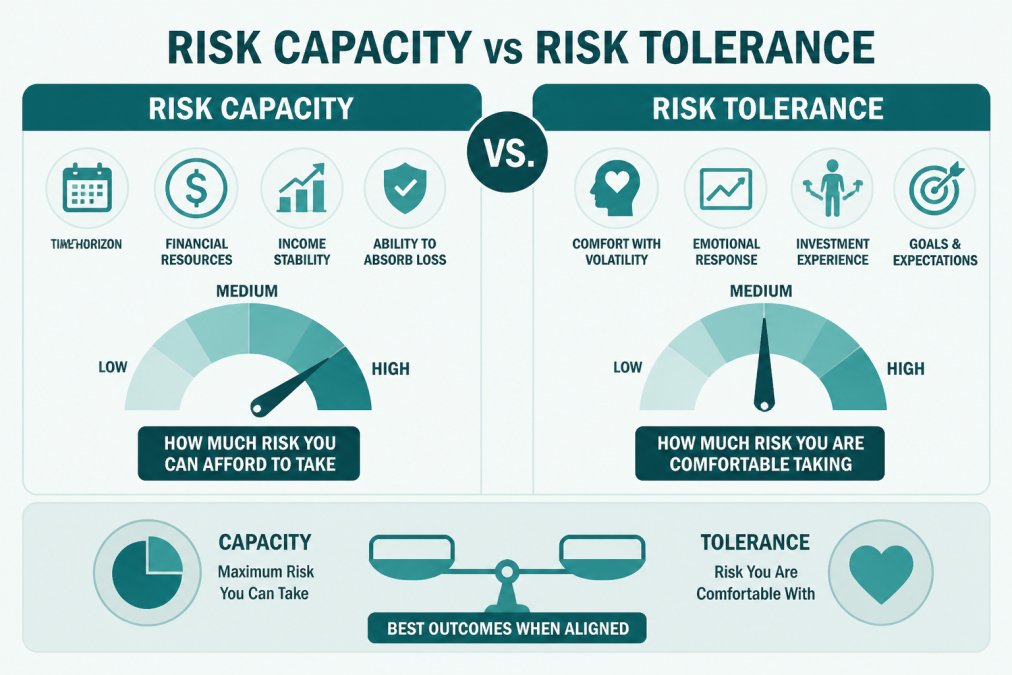
Risk capacity is the amount of volatility your financial situation can actually absorb. It's determined by your time horizon, income, savings rate, and required withdrawals. A 55-year-old with $2 million saved and a 35-year time horizon has high risk capacity. A 72-year-old living entirely on portfolio withdrawals has low risk capacity, regardless of how brave they feel.
Risk tolerance is your psychological comfort with volatility. Some people sleep fine during market downturns. Others get anxious when their account drops 5%.
How These Two Concepts Shape Your Retirement Strategy
When risk capacity and risk tolerance align, your retirement strategy becomes straightforward. When they diverge, you need a deliberate bridge strategy. If you have high risk capacity but low risk tolerance, you might use a "safety-first" approach: lock in a portion of your portfolio in bonds and fixed income to cover your spending needs for 3-5 years, then invest the remainder more aggressively.
If you have low risk capacity but high risk tolerance, you feel confident taking risk, but your financial situation doesn't support it. A 30% drop when you're already withdrawing 5% annually can derail your entire plan.
How to Calculate Risk Tolerance for Retirement
Calculating your risk tolerance isn't about filling out a questionnaire and getting a score. It's a deliberate process combining quantitative analysis with honest self-reflection.
Step-by-Step Assessment Process
Step 1: Determine Your Time Horizon (5 minutes)
Your time horizon is the number of years until you need the money. For retirement, this typically extends to your life expectancy. If you retire at 65 and expect to live to 90, your time horizon is 25 years. Money you need in the next 3 years has a short time horizon. Money you won't touch for 15 years has a long time horizon.
Step 2: Assess Your Risk Capacity (10 minutes)
Risk capacity is mathematical. Calculate your withdrawal rate: (Annual spending need) ÷ (Total portfolio) = Withdrawal Rate. If this number is above 5%, your risk capacity is lower because you can't afford significant losses without cutting spending. If it's below 3%, you have higher risk capacity.
Step 3: Assess Your Risk Tolerance (15 minutes)
This requires honest answers about your emotional response to volatility:
- How did you feel during the 2020 market decline?
- If your portfolio dropped 20% tomorrow, would you want to sell or stay invested?
- Have you experienced a significant financial loss before? How did you respond?
- Do you prefer certainty even if it means lower returns?
Step 4: Identify the Mismatch (10 minutes)
Compare your risk capacity to your risk tolerance. Are they aligned? If not, what's the gap?
Step 5: Build Your Strategy (varies)
Once you understand your capacity and tolerance, design a portfolio that works for both. This might include a "bucket" strategy with different time horizons, guaranteed income floors, systematic rebalancing, diversification, and regular check-ins.
| Assessment Component | Time Required | Frequency | Key Question |
|---|---|---|---|
| Time Horizon Calculation | 5 minutes | Every 2 years | How many years until you need this money? |
| Risk Capacity Analysis | 10 minutes | Annually | What withdrawal rate can your portfolio support? |
| Risk Tolerance Evaluation | 15 minutes | Every 3 years or after major events | How did you react during past market downturns? |
| Strategy Alignment | 10 minutes | Quarterly | Is your portfolio aligned with both capacity and tolerance? |
Common Mistakes in Self-Assessment
Mistake 1: Using a Single Questionnaire Score
Questionnaires are useful starting points, but they can't capture how you'll actually behave when your portfolio is down 25%.
Mistake 2: Confusing Past Performance with Future Tolerance
"I did fine in 2020" doesn't mean you'll do fine in the next decline. Your age, financial situation, and emotional state all change.
Mistake 3: Ignoring Sequence of Returns Risk
It's not just about average returns, it's about when those returns happen. A market crash in year one of retirement is far more damaging than one in year ten.
Mistake 4: Setting Risk Tolerance Without Understanding Your Spending
You can't assess risk tolerance without knowing exactly how much you need to spend and what sources cover it.
Mistake 5: Assuming Your Spouse Has the Same Risk Tolerance
In couples, one partner is often more conservative and one more aggressive. The conservative partner's risk tolerance sets the limit for the joint portfolio.
Sequence of Returns Risk: The Hidden Threat to Retirement Income
Sequence of returns risk is the danger that market returns arrive in an unfavorable order during your retirement years. It's the single most important risk factor that most investors overlook.
Imagine two investors earning an average 7% annual return over 10 years with different return sequences. Both end with the same total return, but one's portfolio is worth significantly more because the big gains came later, after the portfolio had grown.
Now add withdrawals. If you're withdrawing 5% annually, the order becomes critical. Withdrawing money during down years forces you to sell at depressed prices, crystallizing losses and reducing the base for future growth.
Why Market Timing Matters More in Retirement
During accumulation years, market timing matters less because you're adding money regularly. A market crash is beneficial, you buy more shares at lower prices. In retirement, you're withdrawing money. A crash forces you to sell shares at depressed prices to fund your spending.
The first 5-10 years of retirement are most critical. A major bear market right after retiring can permanently impair your portfolio's ability to support your spending plan.
Protection against sequence of returns risk includes keeping 3-5 years of spending needs in bonds or cash, using a dynamic withdrawal strategy that reduces spending during market declines, diversifying across multiple asset classes, considering guaranteed income sources like annuities or pensions, and rebalancing systematically to lock in gains and buy low.
Key Factors That Shape Your Risk Tolerance
Investment Time Horizon and Financial Goals
Your time horizon is the foundation of risk tolerance. The longer your time horizon, the more risk you can afford to take. A 40-year-old with 25 years until retirement can tolerate more volatility than a 65-year-old in early distribution.
Your financial goals also shape risk tolerance. If your goal is to preserve capital and generate steady income, you need lower risk. If your goal is to grow wealth and leave a legacy, you can tolerate higher risk.
Market Volatility, Emotional Comfort, and Behavioral Biases
Some investors are comfortable watching their account fluctuate 15% or 20%. Others get anxious with 5% swings. Loss aversion means you feel losses more intensely than equivalent gains. Recency bias means you overweight recent market performance. Herd behavior means you panic-sell when everyone else does.
The most dangerous combination is high risk tolerance during bull markets combined with low risk tolerance during bear markets. Protecting yourself requires automating your investment decisions so emotion doesn't drive choices, establishing clear rules before markets decline, regular communication with a financial advisor, diversification that prevents any single loss from feeling catastrophic, and understanding that volatility is the price of growth.
Building a Portfolio That Matches Your Risk Tolerance
Asset Allocation and Diversification Strategies
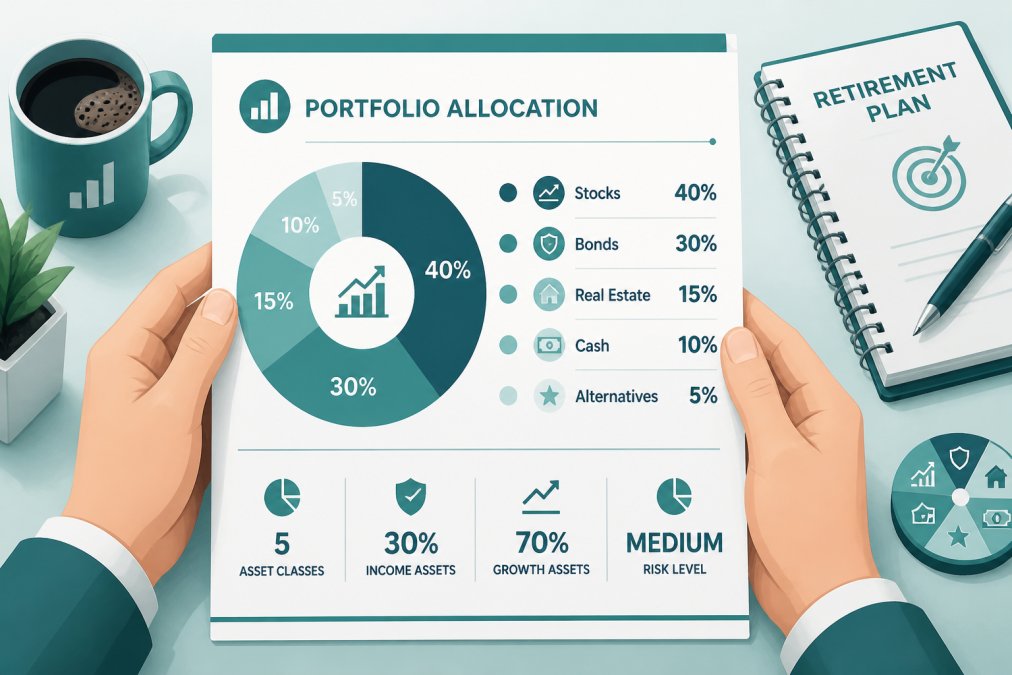
Asset allocation, the split between stocks, bonds, real estate, and other investments, is the primary driver of your portfolio's risk and return. The right allocation depends on your risk tolerance and capacity.
Common allocations by retirement stage:
- Pre-retirement (10+ years to retirement): 70-90% stocks, 10-30% bonds
- Early retirement (0-10 years in): 50-70% stocks, 30-50% bonds
- Mid-retirement (10-20 years in): 40-60% stocks, 40-60% bonds
- Late retirement (20+ years in): 30-50% stocks, 50-70% bonds
Diversification across asset classes provides another layer of risk management. When stocks fall, bonds often rise. By spreading your portfolio across multiple asset classes, you reduce the impact of any single market decline.
Rebalancing and Capital Preservation as You Enter Retirement
Rebalancing is the process of periodically adjusting your portfolio back to your target allocation. If your target is 60% stocks and 40% bonds, but stocks have risen to 70%, you sell some stocks and buy bonds. This forces you to "buy low and sell high", the opposite of the emotional impulse that gets most investors in trouble.
A simple rebalancing rule, quarterly or annually, can significantly improve long-term outcomes and provide psychological comfort.
One effective approach is the "bucket strategy": divide your portfolio into three buckets based on time horizon. Bucket 1 (0-3 years) holds bonds, cash, and stable value funds to cover your spending for the next three years, eliminating the need to sell stocks during downturns. Bucket 2 (3-10 years) contains a balanced portfolio of stocks and bonds for moderate growth with downside protection. Bucket 3 (10+ years) holds a growth-oriented portfolio with higher stock allocation. As you spend from Bucket 1, you replenish it from Bucket 2, and replenish Bucket 2 from Bucket 3 during bull markets.
Why Professional Guidance Matters for Your Retirement Risk Profile
Understanding risk tolerance in retirement planning is complex, and the stakes are high. A portfolio misaligned with your actual risk tolerance can lead to poor decisions that derail your entire retirement plan.
Professional guidance helps by providing objective assessment of your risk tolerance, behavioral coaching during volatile markets to prevent panic-selling, ongoing adjustment as life circumstances change, comprehensive planning that connects risk tolerance to your spending plan and tax strategy, and specialized knowledge in retirement-specific challenges like sequence of returns risk and tax-efficient withdrawals.
At New Insight Financial, we specialize in helping individuals and couples navigate the transition to retirement. Our approach includes personalized retirement income planning, comprehensive risk assessment, and ongoing behavioral coaching. We help you understand your actual risk tolerance and build a portfolio specifically designed to match that tolerance while achieving your financial goals.
Retirement is one of the most significant financial transitions you'll ever make. Getting your risk tolerance right, understanding both your capacity to take risk and your psychological comfort with volatility, is foundational to a secure retirement. The work you do now to assess your risk tolerance honestly and design a portfolio that matches it will pay dividends for decades to come.
If you're approaching retirement and uncertain about your risk tolerance, or if you've built a portfolio that doesn't feel right, it's worth having a conversation with a professional who can assess both your financial situation and your actual comfort with volatility. Get started today with New Insight Financial and build a retirement strategy specifically designed for your risk profile, your goals, and your peace of mind.
Frequently Asked Questions
What's the difference between risk capacity and risk tolerance in retirement planning?
Risk capacity is your financial ability to withstand losses based on income, savings, time horizon, and expenses. Risk tolerance is your psychological comfort with market fluctuations. You might have high risk capacity but low risk tolerance, or vice versa. For successful retirement planning, both must align. A professional assessment considers both to create a strategy you can actually stick with during market downturns.
How do I calculate my risk tolerance for retirement?
Start by assessing three areas: your investment time horizon (years until and through retirement), your financial goals and required income, and your emotional response to market volatility. Consider how you felt during past market downturns. Evaluate your emergency fund and fixed expenses. Then determine what portfolio allocation (stocks vs. bonds) lets you sleep at night while meeting your retirement income needs. Many find working with a financial advisor provides a more realistic assessment than self-evaluation alone.
What is sequence of returns risk and how does it affect my retirement?
Sequence of returns risk is the danger that poor market returns early in your retirement can permanently damage your portfolio, even if long-term returns are strong. If you withdraw money during a market downturn, you sell assets at low prices, reducing future recovery potential. This risk is highest in your first 5-10 years of retirement. Strategies to mitigate it include maintaining a cash buffer, adjusting withdrawals in down markets, and ensuring your asset allocation reflects your true risk tolerance and time horizon.
How should my risk tolerance change as I get closer to retirement?
As your investment horizon shortens, your risk tolerance typically needs to shift. You have less time to recover from market downturns, so a higher allocation to stocks becomes riskier. Most people gradually increase bonds and reduce equities 5-10 years before retirement. However, the shift depends on your specific situation: required income level, pension or Social Security income, health, and how long you expect to live. A personalized retirement plan accounts for your individual circumstances rather than following a one-size-fits-all glide path.
External Sources
[EXTERNAL_LINK: Financial Industry Regulatory Authority retirement planning guidance | finra.org]
[EXTERNAL_LINK: SEC guidance on investor risk tolerance and suitability | sec.gov]
[EXTERNAL_LINK: Vanguard research on sequence of returns risk in retirement | vanguard.com]