 how-to
Protecting Retirement Assets From Inflation: 7 Strategies
Table of Contents
- Why Inflation Threatens Your Retirement Income
- Strategy 1: Build a Diversified Portfolio to Combat Inflation
- Strategy 2: Treasury Inflation-Protected Securities (TIPS) vs Series I Bonds for Retirees
- Strategy 3: Adjusting Retirement Withdrawal Rates for Inflation
- Strategy 4: Real Estate and Commodity Exposure as Hedges
- Strategy 5: Rebalance Your Portfolio Regularly
- Strategy 6: Maximize Tax-Efficient Income and Social Security Planning
- Strategy 7: Scenario Planning to Protect Against Market Volatility
- Frequently Asked Questions
Protecting Retirement Assets From Inflation: 7 Strategies
Last Updated: August 4, 2026
Inflation erodes purchasing power silently and relentlessly. A dollar today buys significantly less than it did five years ago, making protection of retirement assets from inflation one of the most pressing financial challenges for retirees. At New Insight Financial, we work with individuals and couples who understand that a traditional "set it and forget it" retirement plan fails when inflation accelerates. The strategies covered below address how inflation damages retirement income and what you can actually do about it, starting today.
Most retirees built retirement plans around fixed withdrawal amounts, assuming stable purchasing power. When healthcare costs rise 5-6% annually while your portfolio yields 3%, you're losing ground every year. Below, we'll show you exactly how to adjust your portfolio, withdrawal strategy, and planning assumptions to account for real inflation, not the outdated 2-3% figures in many financial models.
Why Inflation Threatens Your Retirement Income
Your purchasing power, the actual goods and services your money can buy, shrinks when inflation rises. A retiree who planned to spend $60,000 annually in 2026 faces a real problem if inflation averages 4% over the next decade: that same lifestyle costs $88,800 by 2036. Most retirement plans fail to account for this compounding effect.
Healthcare costs amplify the problem. Medical inflation typically outpaces general inflation by 1-2 percentage points annually. A couple retiring at 65 faces 25+ years of healthcare expenses, nursing care, prescription drugs, and Medicare supplements, all rising faster than fixed income streams. This healthcare cost squeeze is where many retirement plans fracture.
Watching your purchasing power decline creates genuine anxiety, especially when you're no longer earning a paycheck to compensate. A solid inflation-protection strategy provides both financial security and peace of mind.
Strategy 1: Build a Diversified Portfolio to Combat Inflation
Asset allocation across stocks, bonds, and alternatives forms the foundation of protecting retirement assets from inflation. A portfolio weighted entirely toward bonds or cash loses to inflation; one weighted too heavily toward stocks introduces volatility that can force you to sell at the worst time.
Stocks historically provide inflation protection because companies can raise prices and pass costs to consumers. Over 20-year periods, equity returns have outpaced inflation by approximately 5-7% annually. However, the volatility of reaching that return creates real risk in retirement when you're drawing down capital. The solution isn't to avoid stocks, it's to hold enough equities to grow your portfolio while keeping enough fixed income and alternatives to weather downturns.
Why avoiding excessive cash holdings matters: Cash and money market funds currently yield 4-5%, but inflation runs at 3-4%. You're earning almost nothing in real terms. Retirees often hold 12-24 months of expenses in cash for safety, which is reasonable. Beyond that, cash becomes a drag on long-term purchasing power. Every dollar sitting in a money market account earning 4.5% while inflation runs 3.5% only grows at 1% in real terms.
A practical allocation for a 65-year-old might look like:
- 40-50% equities (domestic and international) for growth and inflation protection
- 30-40% fixed income (bonds, TIPS) for stability and income
- 10-15% alternatives (real estate, commodities) for additional diversification
- 5-10% cash for near-term needs
This allocation isn't rigid; it depends on your risk tolerance, time horizon, and specific circumstances. The key is ensuring you own enough growth assets to outpace inflation over your retirement.
Strategy 2: Treasury Inflation-Protected Securities (TIPS) vs Series I Bonds for Retirees
TIPS are Treasury bonds whose principal value adjusts with the Consumer Price Index. When inflation rises, the principal increases. You receive interest payments based on the adjusted principal, so your income rises with inflation. This direct link to CPI makes TIPS a powerful tool for protecting retirement assets from inflation.
The adjustment happens monthly based on the CPI-U. If inflation runs 4% annually, the principal of a $10,000 TIPS investment grows to approximately $10,400 over that year. You then earn interest on the higher principal amount. At maturity, you receive the inflation-adjusted principal.
Series I Bonds offer a different structure: a fixed rate plus an inflation component that adjusts every six months. A Series I Bond might offer a 1.5% fixed rate plus a 3.2% inflation rate (for a total of 4.7%), with the inflation rate resetting every May and November. The appeal is simplicity and a floor; your return includes that guaranteed fixed component. The drawback is that you cannot access your money for one year, and you forfeit three months of interest if you redeem before five years.
Which option fits your retirement timeline:
TIPS work best if you want regular income and inflation protection. You can build a TIPS ladder, purchasing bonds maturing in 2, 4, 6, 8, and 10 years, so you receive principal back at regular intervals.
Series I Bonds work best for money you won't need for at least five years. They're particularly attractive for legacy planning or funding long-term healthcare reserves. The six-month reset on inflation protection means you're never locked into a low rate if inflation accelerates.
A practical approach: allocate 10-15% of your fixed income to TIPS and consider Series I Bonds for any surplus cash you're building for future healthcare costs.

Strategy 3: Adjusting Retirement Withdrawal Rates for Inflation
The 4% rule, withdrawing 4% of your portfolio in year one and adjusting for inflation thereafter, provides a starting point but requires real discipline. If your portfolio was $1,000,000, you withdraw $40,000 in year one. If inflation is 3%, you withdraw $41,200 in year two. This approach protects purchasing power but assumes you can tolerate portfolio volatility.
Stress testing your spending plan means modeling different inflation scenarios, not just the historical average of 2-3%, but what happens if inflation averages 4-5% over the next decade. How does your portfolio perform if you experience a 30% market decline in year three, inflation spikes to 6%, and you still need to withdraw an inflation-adjusted amount? Many plans fail this test.
A stress-tested approach adjusts your withdrawal rate based on portfolio performance and inflation. In strong market years with low inflation, you might withdraw the full 4% plus inflation. In weak market years with high inflation, you might reduce the withdrawal increase to 50% of inflation, preserving capital for future years.
Real-world example: A retiree with a $1,000,000 portfolio planned to withdraw $40,000 annually. After a 25% market decline and 4% inflation, they faced a choice: withdraw $41,600 (maintaining purchasing power) or withdraw $40,000 (reducing inflation adjustment). By temporarily reducing the inflation adjustment, they preserved $1,600 in portfolio growth during a recovery year.
Strategy 4: Real Estate and Commodity Exposure as Hedges
Real estate historically provides inflation protection because property values and rents rise with inflation. A rental property generates income that increases over time, and the property itself becomes more valuable as replacement costs rise. However, direct real estate ownership requires active management and liquidity challenges.
Real Estate Investment Trusts (REITs) provide real estate exposure without landlord responsibilities. A REIT pools investor capital to purchase and manage properties, distributing rental income to shareholders. REITs typically yield 3-5% annually and provide both income and potential capital appreciation. They're more liquid than direct property ownership and require no active management.
Commodities, oil, metals, agricultural products, provide a different type of hedge. When inflation accelerates, commodity prices often rise, providing portfolio gains that offset inflation's erosion. However, commodities are volatile and provide no income.
A practical approach: allocate 5-10% of your portfolio to REITs for real estate exposure and income. Consider a small allocation (2-5%) to commodity-linked funds if you want direct inflation hedging. The key is avoiding excessive complexity.
Strategy 5: Rebalance Your Portfolio Regularly
Portfolio rebalancing means selling assets that have grown beyond your target allocation and buying assets that have fallen below target. If your target is 45% stocks and 55% bonds, but market gains push stocks to 55%, you sell 10% of stocks and buy bonds. This forces a disciplined "sell high, buy low" approach.
Annual rebalancing works well for most retirees. Trigger-based rebalancing, rebalancing when any asset class drifts more than 5% from target, provides a middle ground. The critical point is maintaining your target allocation despite market movements.
Tax-efficient rebalancing in retirement accounts matters significantly. In tax-deferred accounts (traditional IRAs, 401(k)s), rebalancing creates no immediate tax consequences. In taxable accounts, rebalancing can trigger capital gains taxes. A tax-efficient approach: direct new contributions to underweighted asset classes and use withdrawals from overweighted classes.
Example: Your target is 45% stocks, 55% bonds. Market gains push stocks to 50%. Instead of selling stocks in your taxable account (triggering capital gains taxes), you contribute new money to bonds in your taxable account and withdraw your next distribution from the stock position. Over time, this achieves rebalancing with lower tax drag.
Strategy 6: Maximize Tax-Efficient Income and Social Security Planning
Tax-advantaged accounts, traditional IRAs, Roth IRAs, 401(k)s, allow your investments to compound without annual tax drag. A dollar earning 5% in a taxable account generates tax on that gain; the same dollar in a tax-deferred account compounds at the full 5%. Over 20+ years, this tax deferral compounds into significant wealth preservation.
Withdrawal sequencing, the order in which you withdraw from different account types, affects both taxes and long-term wealth. The general strategy: withdraw from taxable accounts first, then traditional tax-deferred accounts, then Roth accounts last. This preserves Roth accounts (which grow tax-free) for as long as possible.
Social Security cost-of-living adjustments (COLA) are your automatic inflation protection. Each year, Social Security benefits increase by the inflation adjustment, currently tied to the Consumer Price Index. This inflation protection is valuable; one component of your retirement income automatically adjusts for inflation.
Claiming strategy matters. Delaying benefits increases your monthly payment by approximately 8% per year. For someone with strong longevity prospects and a lower portfolio balance, delaying makes sense. For someone with health concerns or immediate income needs, claiming earlier may be optimal.
Strategy 7: Scenario Planning to Protect Against Market Volatility
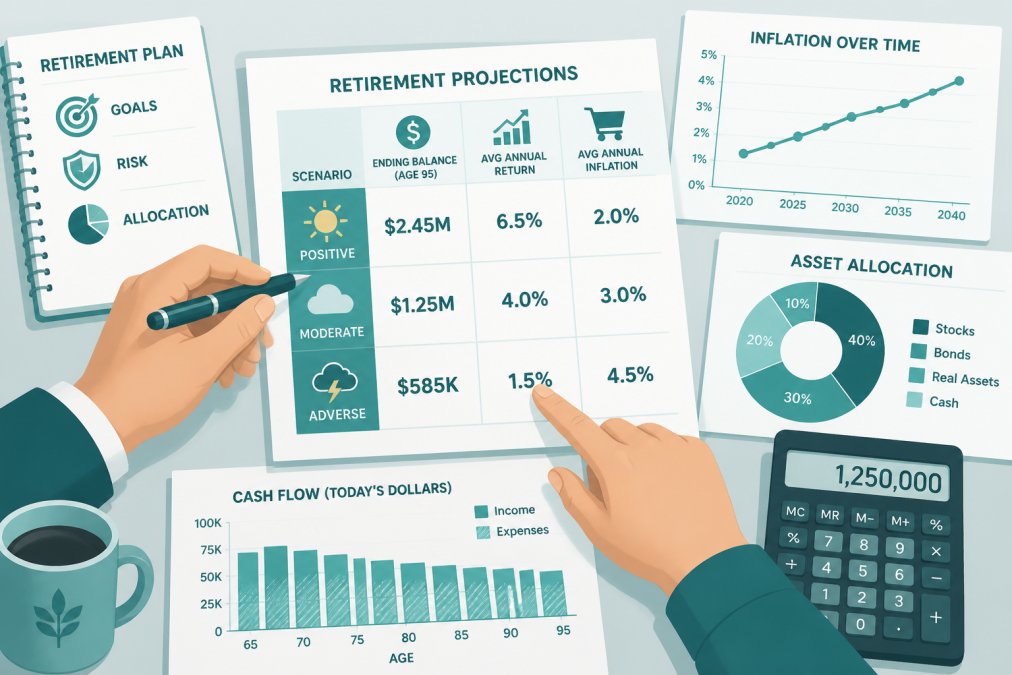
Modeling downturns and inflation spikes means testing your plan against realistic but stressful scenarios. What happens if you retire in 2026, the market drops 30% in 2027, and inflation accelerates to 5%? Can your portfolio sustain your withdrawals? Many plans fail this test, which is why scenario planning reveals problems before they become real.
A practical scenario framework:
- Base case: Historical average returns (7% stocks, 3% bonds), 3% inflation, 4% withdrawal rate
- Inflation spike: Same returns, 5% inflation, 4% withdrawal rate
- Market downturn: 0% stock returns, 2% bond returns, 3% inflation, 4% withdrawal rate
- Stagflation: -10% stock returns, 2% bond returns, 5% inflation, 4% withdrawal rate
Running these scenarios reveals which outcomes threaten your plan. If stagflation causes your portfolio to deplete in year 15 of a 30-year retirement, you know you need either a lower withdrawal rate, a different allocation, or a contingency plan to reduce spending.
| Scenario | Stock Return | Bond Return | Inflation | Portfolio Outcome |
|---|---|---|---|---|
| Base Case | 7% | 3% | 3% | Sustainable |
| Inflation Spike | 7% | 3% | 5% | Tight but workable |
| Market Downturn | 0% | 2% | 3% | Requires discipline |
| Stagflation | -10% | 2% | 5% | High risk |
Protecting retirement assets from inflation is not a one-time decision; it's an ongoing process of monitoring, adjusting, and stress-testing your assumptions against real-world conditions. The strategies above address the mechanics of inflation protection, but execution requires professional guidance tailored to your specific situation. New Insight Financial provides comprehensive retirement planning that integrates income planning, Social Security optimization, and Medicare navigation with portfolio management. Our approach stress-tests your plan against inflation scenarios, healthcare cost projections, and market volatility, ensuring you have genuine confidence in your retirement strategy. Get started today and transform your retirement plan from a static spreadsheet into a living, adaptable strategy that protects your purchasing power for decades to come.
Frequently Asked Questions
How does inflation impact my retirement savings over time?
Inflation erodes your purchasing power, meaning the same dollar buys less each year. If inflation averages 3% annually, a $50,000 annual retirement income will have the purchasing power of roughly $37,000 in 10 years. This is why protecting retirement assets from inflation through diversification, TIPS, and adjusted withdrawal rates is critical to maintaining your standard of living throughout retirement.
Should I choose TIPS or Series I bonds to protect my retirement portfolio?
TIPS adjust their principal value based on the Consumer Price Index, providing real rate of return protection. Series I bonds offer a fixed rate plus an inflation component that adjusts every six months. TIPS work better for longer time horizons and provide liquidity; Series I bonds suit conservative investors willing to hold for at least one year. Consider your withdrawal timeline and need for liquidity when deciding between them.
How should I adjust my retirement withdrawal rate if inflation spikes?
Many retirees use the 4% rule as a baseline, then adjust annually for inflation. If inflation rises sharply, stress test your spending plan to ensure your portfolio can sustain higher withdrawals. Some advisors recommend reducing equity exposure and increasing fixed income during high-inflation periods. A personalized withdrawal strategy should account for your specific cost-of-living needs and market conditions.
What role does Social Security's cost-of-living adjustment play in managing inflation risk?
Social Security benefits receive annual Cost-of-Living Adjustments (COLA) tied to inflation, helping protect your baseline retirement income. However, COLA adjustments may not fully offset healthcare inflation or other rising costs. Combining Social Security COLA protection with diversified investments, TIPS, and real estate exposure creates a more comprehensive inflation hedge for your retirement assets.