 comparison
Medicare Supplement vs Advantage Plans: 2026 Comparison Guide
Table of Contents
- Medicare Supplement vs Advantage Plans: Understanding Your Core Options
- What is Original Medicare?
- How Medicare Advantage (Part C) Works
- What is Medicare Supplement (Medigap)?
- Medicare Advantage Plan Benefits and Coverage
- Medigap vs Medicare Advantage: Key Differences Explained
- Medicare Costs Comparison: Premiums, Deductibles, and Copayments
- Medicare Enrollment Periods and Plan Selection Timing
- Scenario-Based Decision Matrix: Which Plan Is Right for You?
- Prescription Drug Coverage (Part D) and Coordination of Benefits
- Common Myths About Medicare Supplement vs Advantage Plans
- Frequently Asked Questions
Last Updated: July 20, 2026
Choosing between a medicare supplement vs advantage plans is one of the most consequential decisions you'll make as a Medicare beneficiary. According to research from Centers for Medicare & Medicaid Services, nearly 42 million Americans rely on Medicare for their health coverage, yet many make enrollment decisions without fully understanding the long-term financial and coverage implications of each option.
This guide breaks down the critical differences between Medicare Supplement (Medigap) and Medicare Advantage plans, explains the hidden costs and switching traps that catch most beneficiaries off guard, and gives you a framework for deciding which path makes sense for your specific situation.
Medicare Supplement vs Advantage Plans: Understanding Your Core Options
The fundamental distinction between these two approaches determines everything else: Medicare Advantage replaces Original Medicare with a private insurance plan, while Medicare Supplement (Medigap) works alongside Original Medicare to fill coverage gaps.
With Original Medicare, you get Part A (hospital insurance) and Part B (medical insurance) directly from the federal government. You pay a monthly Part B premium, an annual deductible for Part A, and cost-sharing (copayments and coinsurance) when you use healthcare services. Original Medicare has no out-of-pocket maximum, meaning catastrophic illness could cost you tens of thousands of dollars.
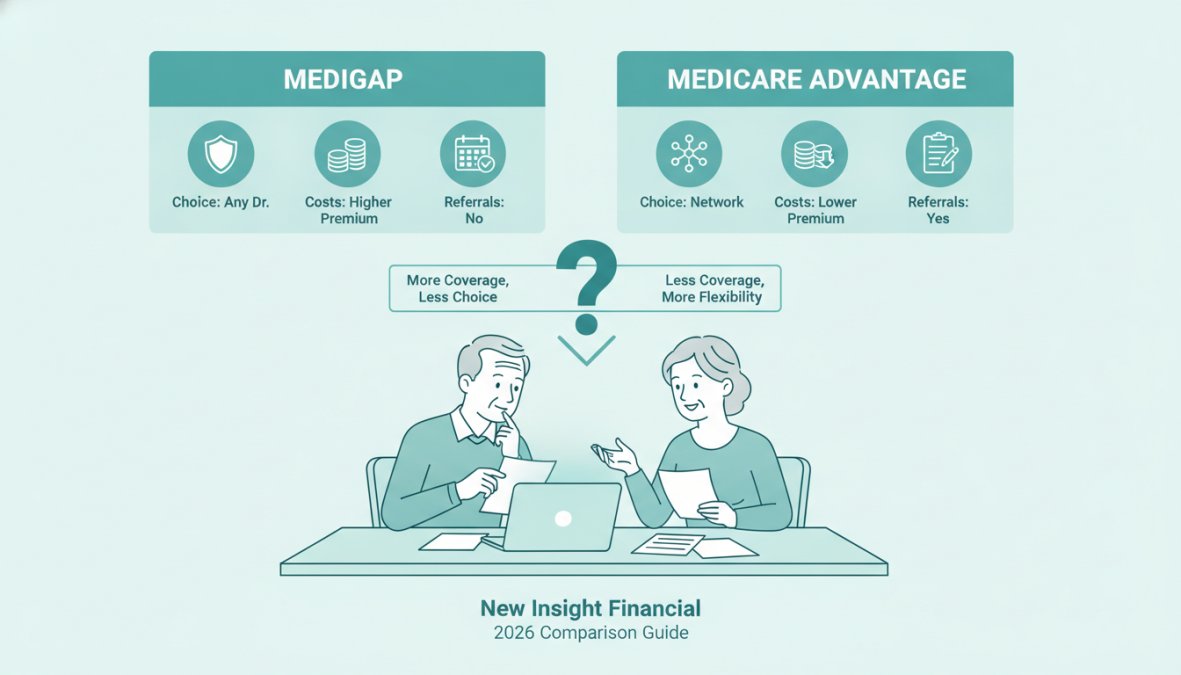
A Medigap policy is sold by private insurance companies and pays some or all of your cost-sharing under Original Medicare. A Medicare Advantage plan is a private alternative to Original Medicare itself, includes Part A and Part B coverage, usually adds Part D (prescription drug coverage), and often includes dental, vision, and hearing benefits. The trade-off: Advantage plans use networks, require prior authorization for many services, and impose annual out-of-pocket maximums.
What is Original Medicare?
Original Medicare is the federal health insurance program that covers Americans age 65 and older. Part A covers inpatient hospital stays, skilled nursing facility care, hospice, and some home health services. Part B covers doctor visits, outpatient services, diagnostic tests, and preventive care.
In 2026, the Part A deductible is $1,676 per benefit period. After you meet the deductible, Medicare covers 100% of hospital costs for days 1-60, 75% for days 61-90, and 50% for days 91-150. For Part B, you pay a monthly premium (income-dependent), a $240 annual deductible, and then 20% coinsurance for most services after the deductible is met. Original Medicare has no out-of-pocket maximum and doesn't cover prescription drugs (Part D), dental, vision, or hearing.
How Medicare Advantage (Part C) Works
Medicare Advantage is a private insurance alternative to Original Medicare. When you enroll in an Advantage plan, the plan assumes responsibility for covering your Part A and Part B benefits and must cover at least the same services as Original Medicare.
Most Medicare Advantage plans include Part D prescription drug coverage and extra benefits like dental, vision, hearing, and fitness programs. In exchange, you typically pay a monthly premium, use in-network providers (with higher costs for out-of-network care), and must follow prior authorization requirements for certain services. Advantage plans have annual out-of-pocket maximums, meaning once you hit the limit, the plan covers 100% of in-network care for the rest of the year.
Plans come in three main network types: HMO (Health Maintenance Organization) requires you to use in-network providers and get referrals for specialists; PPO (Preferred Provider Organization) allows out-of-network use at higher cost without referrals; and PFFS (Private Fee-for-Service) is rare.
What is Medicare Supplement (Medigap)?
Medigap policies are standardized insurance products sold by private insurers that pay some or all of your cost-sharing under Original Medicare. There are 10 standardized Medigap plans (A, B, C, D, F, G, K, L, M, N), each offering a different combination of benefits.
Plan F and Plan G are the most comprehensive and popular. Plan F (available only to those who were eligible before January 1, 2020) covers the Part A deductible, Part B deductible, Part B excess charges, and coinsurance. Plan G covers everything Plan F does except the Part B deductible. All Medigap policies must cover Part A coinsurance, hospital costs beyond 150 days, Part B coinsurance, and 100% of medically necessary emergency care received outside the U.S. The critical distinction: Medigap policies work with Original Medicare and any provider that accepts Medicare. You don't have networks, referral requirements, or prior authorization hurdles. The trade-off is higher monthly premiums, with Plan G in 2026 averaging $150-200+ per month depending on your age and location.
Medicare Advantage Plan Benefits and Coverage
Medicare Advantage plans must cover everything Original Medicare covers, but they add extras that Original Medicare doesn't. Most plans include dental (cleanings, fillings, sometimes crowns), vision (eye exams, glasses or contacts), hearing (exams and hearing aids), and fitness benefits.
These extras appeal to many beneficiaries because Original Medicare covers none of them. However, the scope of these benefits varies dramatically by plan. One Advantage plan might cover $1,500 in dental benefits annually; another might cover $1,000. You must read the plan's Summary of Benefits to know exactly what's covered.
Extra Benefits Beyond Original Medicare
Many Advantage plans offer additional benefits: meal delivery programs, transportation to medical appointments, in-home support services, telehealth, acupuncture, chiropractic care, and wellness programs. These benefits come with limits. A meal delivery benefit might cover 14 meals per month for the first three months only. The value of these extras depends entirely on your health needs and actual usage.
Provider Networks: HMO vs PPO vs Original Medicare
With Original Medicare plus Medigap, you can see any provider that accepts Medicare, which is nearly all doctors and hospitals in the U.S. You don't need referrals, prior authorization, or approval from an insurance company.
HMO Advantage plans restrict you to in-network providers (except emergencies). You must choose a primary care physician who coordinates your care and provides referrals to specialists. If you see an out-of-network provider, you pay the full cost. PPO Advantage plans allow out-of-network care at higher cost-sharing without requiring a primary care physician or referrals, but out-of-network copayments are typically 2-3 times higher than in-network copayments.
Medigap vs Medicare Advantage: Key Differences Explained
Advantage plans cap your annual out-of-pocket costs; Medigap plans don't have caps but cover most cost-sharing upfront. Advantage plans use networks; Medigap works with any Medicare provider. Advantage plans include prescription drug coverage; Medigap requires a separate Part D plan. Advantage plans add dental and vision; Medigap doesn't.
The real differences emerge in your actual healthcare usage. If you're healthy and rarely see doctors, an Advantage plan's low or zero premium saves money. If you have multiple chronic conditions requiring frequent specialist visits, Medigap's predictable cost-sharing and provider freedom may cost less overall.
Coverage Gaps and Out-of-Pocket Costs
Original Medicare leaves significant gaps. It doesn't cover prescription drugs, dental, vision, hearing, long-term care, or routine physical exams. Medigap plans cover the gaps in Original Medicare's cost-sharing (deductibles and coinsurance), but they don't cover the benefits Original Medicare doesn't offer. Medicare Advantage plans cover most gaps by including Part D, dental, vision, and hearing, though coverage is limited. Dental benefits cap out at $1,000-2,000 annually, and vision benefits typically cover one eye exam and one pair of glasses per year.
Medical Underwriting and Guaranteed Issue Rights
This is the trap that catches most people when switching between plans. When you first become eligible for Medicare at 65, you have a guaranteed issue right, and insurance companies must sell you any Medigap policy without medical underwriting, regardless of pre-existing conditions.
But if you miss this window and try to switch from an Advantage plan to a Medigap plan later, the insurance company can deny you, charge a higher premium, or exclude pre-existing conditions. The guaranteed issue period for Medigap is your Initial Enrollment Period (IEP), the six-month window starting the first day of the month you turn 65. If you enroll in Medicare and buy a Medigap policy during this window, you're protected. There are limited exceptions: if your Advantage plan exits your area, you have a guaranteed issue right to switch to Medigap.
Medicare Costs Comparison: Premiums, Deductibles, and Copayments
Cost is rarely straightforward when comparing these options because each involves different cost components. An Advantage plan might have a $0 premium but $25 copayments for doctor visits. A Medigap plan might have a $180 premium and $0 copayments. The total annual cost depends on how much healthcare you use.
Medicare Advantage Cost Structure
Most Medicare Advantage plans in 2026 have zero or low monthly premiums. But they charge copayments and coinsurance for services. A typical HMO Advantage plan might charge $25 for primary care visits, $50 for specialist visits, $250 for inpatient hospital admission, and 20% coinsurance for outpatient surgery. The annual out-of-pocket maximum for 2026 is typically $6,700-7,000 for in-network care.
For a beneficiary with minimal healthcare needs, this structure is cost-effective. If you see your primary care doctor twice a year and take one generic medication, your annual cost might be $50 (premium) + $50 (two copays) + $60 (medication) = $160. But for someone with chronic conditions, copayments add up quickly.
| Cost Component | Medicare Advantage | Original Medicare + Medigap |
|---|---|---|
| Monthly Premium | $0-50 | $180-250 |
| Annual Deductible | $0 (usually) | $240 (Part B) |
| Doctor Visit Copay | $25-50 | $0 (Plan G) |
| Specialist Copay | $50-75 | $0 (Plan G) |
| Out-of-Pocket Cap | $6,700-7,000 | None |
| Dental Coverage | Limited ($1,000-2,000/year) | Not included |
| Vision Coverage | Limited (1 exam/year) | Not included |
Medicare Supplement Cost Structure
Medigap plans have higher monthly premiums but lower or zero cost-sharing. Plan G in 2026 averages $150-200 monthly depending on age and location, but it covers your Part B deductible and most coinsurance. With Plan G at $180/month ($2,160 annually) plus the $240 Part B deductible, your annual cost is $2,400 before any healthcare usage.
Medicare Enrollment Periods and Plan Selection Timing
When you can enroll in Medicare and when you can switch plans is tightly regulated. Missing deadlines carries permanent consequences.
Your Initial Enrollment Period (IEP) is the six-month window starting the first day of the month you turn 65. If you enroll in Medicare during this window, you avoid late enrollment penalties. During your IEP, you can enroll in Original Medicare plus any Medigap plan without medical underwriting.
After your IEP, you can change Medicare plans only during specific windows. The Annual Enrollment Period (AEP) runs October 15 to December 7 each year. During AEP, you can switch between Advantage plans, drop Advantage and switch to Original Medicare, or change your Part D plan. Every October, your current plan sends an Annual Notice of Change (ANOC) detailing any changes to premiums, copayments, deductibles, networks, or covered drugs for the next year.
Switching Costs and Underwriting Traps
The biggest trap is switching from an Advantage plan to a Medigap plan after your IEP. If you enroll in an Advantage plan at 65 and later want to switch to Medigap, the insurance company can underwrite you. If you've developed diabetes, high blood pressure, or any other condition, the insurer can deny you, charge a higher premium, or exclude the condition. Some states have limited protections, but most don't. This means an Advantage plan that's fine at 65 can become a trap at 75 if your health needs change and your doctors aren't in the new plan's network.
Scenario-Based Decision Matrix: Which Plan Is Right for You?
The right choice depends on your specific situation.
When Medicare Advantage Makes Sense
Advantage plans are ideal if you're in good health with few chronic conditions, have no strong attachments to specific doctors, want comprehensive dental and vision coverage, prefer predictable capped annual out-of-pocket costs, and are willing to navigate prior authorization requirements. A 68-year-old with controlled high blood pressure, no other chronic conditions, seeing her primary care doctor twice yearly and taking one generic medication is an ideal Advantage candidate.
When Medicare Supplement Makes Sense
Medigap is ideal if you have multiple chronic conditions requiring frequent specialist visits, have established relationships with specific doctors you want to keep, are willing to pay higher premiums for predictable cost-sharing and provider freedom, and want to avoid network restrictions and prior authorization requirements. A 72-year-old with diabetes, heart disease, and arthritis, seeing multiple specialists monthly, is an ideal Medigap candidate.
| Scenario | Best Choice | Why |
|---|---|---|
| Healthy, minimal healthcare use, no doctor attachments | Medicare Advantage | Low premiums, capped costs, extra benefits |
| Multiple chronic conditions, frequent specialist visits | Medicare Supplement | Predictable costs, provider freedom, no networks |
| Good health but strong doctor attachments | Medicare Supplement | Guarantees you keep your doctors |
| Significant hearing or dental needs | Medicare Advantage | Covers benefits Original Medicare doesn't |
| Anticipate future health changes | Medicare Supplement | Guaranteed issue rights locked in at 65 |
Prescription Drug Coverage (Part D) and Coordination of Benefits
Prescription drug coverage is mandatory if you take regular medications. Part D is a separate benefit that requires enrollment, and missing the deadline carries permanent penalties.
Most Medicare Advantage plans include Part D coverage, which simplifies enrollment. With Original Medicare plus Medigap, you must enroll in a standalone Part D plan. Medigap covers cost-sharing under Original Medicare but doesn't cover Part D copayments. The Inflation Reduction Act improved Part D coverage by capping out-of-pocket costs at $2,000 annually for Medicare beneficiaries starting in 2025, meaning once you've paid $2,000 out of pocket for covered drugs, your plan covers 100% of the cost for the rest of the year.
Common Myths About Medicare Supplement vs Advantage Plans
Myth 1: "Medicare Advantage plans are always cheaper." Not true. While premiums are lower, copayments add up. For beneficiaries with significant healthcare needs, total annual costs can exceed Medigap costs.
Myth 2: "You can have both Medicare Advantage and Medigap." Not true. If you enroll in an Advantage plan, you cannot also have a Medigap policy.
Myth 3: "Medigap plans cover everything Original Medicare doesn't." Not true. Medigap covers cost-sharing gaps but doesn't cover benefits Original Medicare doesn't offer, like dental, vision, or hearing.
Myth 4: "You can switch from Advantage to Medigap anytime." Partially true. You can switch during your AEP, but outside that window, you may face medical underwriting.
Myth 5: "Advantage plans always include dental and vision." Not necessarily. While most do, the coverage is limited.
Myth 6: "Original Medicare is free." Not true. You pay a monthly Part B premium, an annual Part A deductible, and cost-sharing for services.
Choosing between medicare supplement vs advantage plans is ultimately a decision about risk tolerance and healthcare usage. If you're healthy and want low premiums with capped costs, Advantage makes sense. If you have chronic conditions, value provider freedom, or want predictable cost-sharing, Medigap is worth the higher premium.
The critical decision point is your Initial Enrollment Period at 65. That's when you have guaranteed issue rights for Medigap, a protection you lose if you choose Advantage and later want to switch. At New Insight Financial, we help beneficiaries work through this decision by analyzing their specific health needs, doctor relationships, and financial situation. Get started with New Insight Financial and secure your Medicare strategy before your enrollment deadline passes.
Frequently Asked Questions
Can you have both Medicare Advantage and a Medicare Supplement plan at the same time?
No, you cannot have both Medicare Advantage (Part C) and a Medicare Supplement (Medigap) plan simultaneously. If you have Medicare Advantage, you already have Part A and Part B coverage through that plan, so adding Medigap would be redundant and wasteful. However, you can switch between them during the open enrollment period, though switching from Advantage to Supplement may require medical underwriting depending on your state and circumstances.
What are the main differences in costs between Medicare Supplement and Medicare Advantage plans?
Medicare Advantage typically has lower or zero monthly premiums but higher out-of-pocket costs (copayments, deductibles, coinsurance) when you use healthcare services. Medicare Supplement has higher monthly premiums but lower out-of-pocket costs, you pay the premium regardless of healthcare use. Supplement plans also cover gaps like Part A deductibles and coinsurance that Original Medicare leaves uncovered. Your total annual costs depend on your expected healthcare needs.
Do Medicare Advantage plans include prescription drug coverage?
Many Medicare Advantage plans include integrated prescription drug coverage (Part D), but not all. Some plans require you to enroll in a separate Part D plan for medications. If you choose Original Medicare with a Medigap plan, you must enroll in a standalone Part D plan to cover prescription drugs. Always verify your specific plan's drug coverage details on Medicare.gov or by contacting the plan directly.
What happens to my coverage if I switch from Medicare Advantage to Medicare Supplement?
When switching from Medicare Advantage to Medigap, you may face medical underwriting in most states, meaning the insurance company can deny coverage or charge higher premiums based on your health history. However, if you switch during your first year of Medicare or during specific guaranteed issue periods, you have protection from underwriting. It's critical to understand your state's rules and timing before switching to avoid coverage gaps and unexpected costs.
Which plan offers more flexibility in choosing doctors and specialists?
Medicare Supplement (Medigap) paired with Original Medicare offers the most flexibility, you can see any doctor or specialist who accepts Medicare without referrals or network restrictions. Medicare Advantage plans typically use HMO or PPO networks, which limit your provider choices. HMO plans require you to use in-network doctors and get referrals for specialists, while PPO plans offer more flexibility but still restrict out-of-network care. If provider choice is your priority, Original Medicare with Medigap is the better option.