 listicle
10 Medicare Enrollment Mistakes to Avoid in 2026
Table of Contents
- 1. Missing Your Initial Enrollment Period and Facing Permanent Penalties
- 2. Overlooking Special Enrollment Periods When Life Changes
- 3. Confusing Original Medicare and Medicare Advantage Without Understanding the Real Differences
- 4. Ignoring Prescription Drug Coverage and the Part D Enrollment Window
- 5. Failing to Review the Annual Notice of Change and Missing Critical Plan Updates
- 6. Not Checking Provider Networks and Discovering Out-of-Network Surprises
- 7. Misunderstanding Medicare Premiums, Deductibles, and Out-of-Pocket Costs
- 8. Ignoring Medicare and Health Savings Account Interactions
- 9. Missing Medigap Guaranteed Issue Rights and Facing Underwriting Delays
- 10. Delaying Enrollment While Still Working and Losing Employer Coverage Protections
- Frequently Asked Questions
Last Updated: July 23, 2026
Medicare enrollment can feel overwhelming, but understanding the most common enrollment mistakes is the single best way to protect your coverage and wallet. According to the Centers for Medicare & Medicaid Services, millions of beneficiaries miss critical deadlines each year, triggering penalties that can last a lifetime. At New Insight Financial, we help clients navigate these complex decisions. Below are the ten most critical enrollment mistakes and how to avoid them.
1. Missing Your Initial Enrollment Period and Facing Permanent Penalties
Your Initial Enrollment Period is a seven-month window centered on your 65th birthday: three months before, the month you turn 65, and three months after. Missing this window for Medicare Part A and Part B triggers permanent late enrollment penalties.
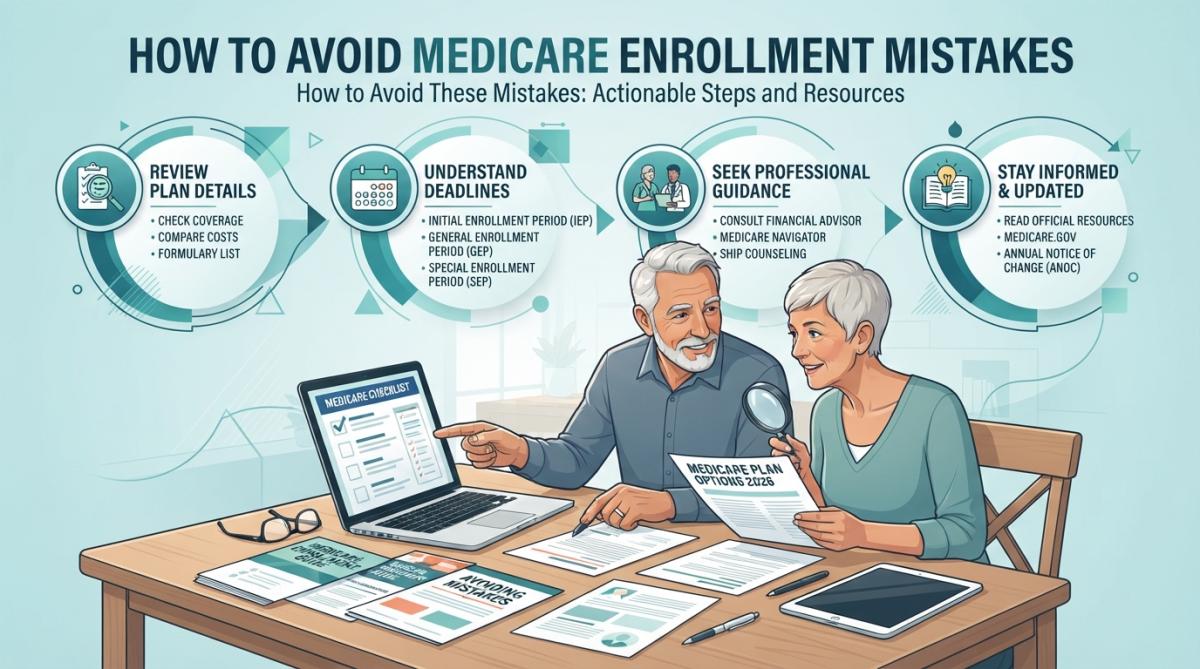
The Part B penalty is 10% of the standard premium for each year you delay. Waiting five years past your Initial Enrollment Period means a permanent 50% surcharge on your monthly premium. Part D (prescription drug coverage) carries a 1% monthly penalty for each month of delay. These penalties apply every month you're enrolled in Medicare.
An exception exists if you have creditable coverage through an employer or spouse's employer, coverage at least as good as Medicare's standard Part D. You can delay Part D enrollment without penalty, but you must prove it. Many people assume their employer plan qualifies and later discover it doesn't.
2. Overlooking Special Enrollment Periods When Life Changes
Special Enrollment Periods give you a second chance to enroll outside the standard Initial Enrollment Period. These windows open when specific life events occur, losing employer-sponsored insurance, moving out of your plan's service area, getting married or divorced, or losing Medicaid.
You typically have 60 days from the qualifying event to enroll. If your employer plan ends on June 15, you have until August 14 to act. After that, you're locked out until October's Open Enrollment. Many people don't realize they qualify for a Special Enrollment Period and miss the deadline.
3. Confusing Original Medicare and Medicare Advantage Without Understanding the Real Differences
Original Medicare consists of Part A (hospital insurance) and Part B (medical insurance). You receive care from any provider nationwide who accepts Medicare with no network restrictions or referral requirements. However, you pay deductibles, coinsurance, and copayments, and need supplemental coverage (Medigap) to manage out-of-pocket costs.
Medicare Advantage is an alternative offered by private insurers that includes Part A, Part B, and usually Part D. These managed care plans have networks, referral requirements, and often lower out-of-pocket costs, but restrict you to in-network providers except in emergencies.
The fundamental difference is control versus cost. Original Medicare offers maximum freedom but requires supplemental insurance. Medicare Advantage limits choices but typically has lower premiums and predictable out-of-pocket maximums. A $0 premium Medicare Advantage plan might have a $6,700 out-of-pocket maximum and require referrals, while Original Medicare with Medigap might cost $200 monthly but provide unlimited access nationwide.
4. Ignoring Prescription Drug Coverage and the Part D Enrollment Window
Medicare Part D is optional, but skipping it without creditable coverage triggers a permanent 1% monthly penalty. Delaying enrollment for three years means a 36% permanent surcharge.
Part D plans vary dramatically in cost and coverage. The same medication might cost $15 monthly on one plan and $150 on another. Formularies differ by plan, and some cover your medications while others don't. The coverage gap, or "donut hole," creates a spending threshold where you pay more out-of-pocket before catastrophic coverage kicks in.
Beneficiaries often enroll in the cheapest plan, only to discover their medications aren't covered or require prior authorization. The Annual Notice of Change arrives in September and details plan changes for the coming year. Formulary changes are common, a medication covered at $5 might move to $50. If you don't review this notice, you won't know until January.
| Mistake | Impact | How to Avoid |
|---|---|---|
| Missing Part D enrollment deadline | 1% monthly penalty for life | Enroll during Initial Enrollment Period or within 63 days of losing creditable coverage |
| Not reviewing formulary changes | Unexpected copay increases | Read Annual Notice of Change each September |
| Choosing plan by premium alone | Higher out-of-pocket costs | Use Medicare.gov Plan Finder and enter your medications |
| Ignoring coverage gaps | Large unexpected expenses | Understand the donut hole threshold for your plan |
5. Failing to Review the Annual Notice of Change and Missing Critical Plan Updates
Every year, Medicare plans send an Annual Notice of Change detailing premium changes, deductible shifts, copayment increases, drug formulary updates, and provider network changes. Many beneficiaries skip reading the ANOC because it's lengthy and technical, assuming their plan stays the same. In reality, plans change constantly.
The Open Enrollment Period runs October 15 through December 7 each year. This is your window to switch plans if your current plan no longer meets your needs. If you don't review the ANOC and act during Open Enrollment, you're locked into your plan for another year.
Set a calendar reminder for mid-September. When the notice arrives, spend 30 minutes reviewing it. Compare your current plan's changes against alternatives using the Medicare.gov Plan Finder. If a better option exists, switch during Open Enrollment.
6. Not Checking Provider Networks and Discovering Out-of-Network Surprises
Medicare Advantage plans operate networks; Original Medicare does not. If you choose a Medicare Advantage plan, your doctors must be in-network for standard rates. Out-of-network care is limited and expensive.
Many beneficiaries don't verify their doctor's network status before enrolling. Networks change annually. A doctor in-network one year might leave the next. Call your doctor's office and ask which Medicare Advantage plans they accept. Use the plan's online directory to verify before you enroll.
For Original Medicare, this isn't an issue. Any provider who accepts Medicare accepts you. This flexibility is one reason Original Medicare appeals to people with established healthcare relationships. If you travel frequently or spend time in multiple states, Original Medicare's nationwide coverage provides more security.
7. Misunderstanding Medicare Premiums, Deductibles, and Out-of-Pocket Costs
Many people believe Medicare is free at 65. This is incorrect. Most beneficiaries pay premiums for Part B and Part D, plus deductibles and coinsurance.
Part A is premium-free for most beneficiaries who paid Medicare taxes for at least 10 years. Part B has a monthly premium that increases with income. In 2026, the standard Part B premium is $164.90 monthly, but higher-income beneficiaries pay up to $560 monthly based on Modified Adjusted Gross Income from two years prior.
Original Medicare has an annual Part B deductible of $240. After meeting the deductible, you typically pay 20% coinsurance. There's no annual out-of-pocket maximum, meaning costs can be unlimited. This is why Medigap supplemental insurance is essential.
Medicare Advantage plans have deductibles and out-of-pocket maximums. The 2026 maximum for in-network services is $8,550. Once reached, the plan pays 100% of covered services for the rest of the year.
Part D has a coverage gap. In 2026, once you and your plan spend $5,735 on covered drugs, you enter the gap and pay 25% of drug costs until your total out-of-pocket spending reaches $8,550. Then catastrophic coverage begins and you pay only 5%.
8. Ignoring Medicare and Health Savings Account Interactions
Health Savings Accounts are triple-tax-advantaged accounts paired with high-deductible health plans. When you enroll in Medicare Part A, you become ineligible to contribute to an HSA. Your balance remains and can be used for Medicare-eligible expenses, but contributions stop.
If you're still working and covered by a high-deductible health plan with an HSA, enrolling in Part B doesn't affect HSA eligibility. But enrolling in Part A does. Many people don't realize this distinction and inadvertently trigger HSA ineligibility.
Once you enroll in Medicare, your HSA can only be used for Medicare-qualified expenses. You cannot use HSA funds for non-Medicare health expenses without triggering taxes and penalties. For people with substantial HSA balances, this interaction matters significantly. Consulting with a tax advisor before enrolling in Medicare helps you optimize HSA strategy.
9. Missing Medigap Guaranteed Issue Rights and Facing Underwriting Delays
Medigap is supplemental insurance that covers gaps in Original Medicare: deductibles, coinsurance, and copayments. The critical enrollment window is the six-month period following your Medicare Part B effective date. During this window, insurers must offer you Medigap coverage without underwriting, regardless of health status.
If you miss this window, insurers can underwrite your application, deny coverage based on health conditions, charge more, or exclude pre-existing conditions. Many people delay Medigap enrollment thinking they'll shop around later. By the time they're ready, the guaranteed issue window has closed.
State rules vary significantly. Some states offer additional guaranteed issue periods; others have high-risk pools for people denied Medigap. Understanding your state's specific rules prevents costly mistakes.
10. Delaying Enrollment While Still Working and Losing Employer Coverage Protections
If you're still working at 65 and covered by your employer's health plan, you can delay Medicare enrollment if your employer plan is creditable coverage. However, delaying creates timing risks. If you leave your job unexpectedly, your employer coverage ends and you have 63 days to enroll in Medicare without penalty.
Many people underestimate how quickly employment situations change. When this happens, you need to act fast. The 63-day window is short.
COBRA coverage doesn't extend your enrollment window. COBRA allows you to continue employer coverage for 18 months after employment ends, but if you don't enroll in Medicare within 63 days of losing employer coverage, you face penalties.
The safest approach is enrolling in Medicare Part A at 65 (it's premium-free) while keeping your employer plan. You can delay Part B if you have creditable coverage, but Part A should not be delayed. This protects you from Part A penalties and ensures seamless coverage if employment ends.
Navigating Medicare enrollment is complex, but avoiding these ten mistakes protects your coverage and prevents costly penalties. The consequences of enrollment errors, permanent surcharges, coverage gaps, and limited provider networks, compound over decades of retirement. New Insight Financial specializes in helping clients coordinate Medicare enrollment with their broader retirement strategy, including income planning and healthcare cost management. With personalized guidance and access to tools like our Generational Vault® for organizing important healthcare documents, you can approach Medicare enrollment with confidence. Get started with New Insight Financial today to ensure your retirement healthcare plan aligns with your financial goals.
Frequently Asked Questions
What happens if I miss my Initial Enrollment Period (IEP) for Medicare?
Missing your Initial Enrollment Period triggers a late enrollment penalty that increases your Medicare Part B and Part D premiums permanently. The penalty is 10% per year for Part B and 1% per month for Part D, applied for as long as you have Medicare. You may qualify for a Special Enrollment Period (SEP) if you had creditable coverage through an employer or COBRA, but without one, the penalty is difficult to reverse. Acting quickly to enroll can sometimes trigger an appeals process to waive penalties in specific circumstances.
How do Medicare and Health Savings Accounts (HSAs) interact during enrollment?
Once you enroll in any part of Medicare (Part A, B, or D), you become ineligible to contribute to an HSA, even if you maintain an HSA-eligible health plan. Many people delay Medicare enrollment while working to preserve HSA contributions, but this requires careful coordination with employer coverage. If you have an active HSA and are approaching Medicare eligibility, consult a financial advisor about withdrawal strategies and timing to avoid penalties. Some retiree benefits or COBRA coverage may allow continued HSA contributions if you haven't enrolled in Medicare yet.
What is the difference between Original Medicare and Medicare Advantage when choosing a plan?
Original Medicare (Part A and Part B) is a fee-for-service plan administered by the federal government with no provider network restrictions, you can see any Medicare-accepting doctor. Medicare Advantage (Part C) is a private alternative that bundles Part A, B, and often Part D into one plan, typically with lower out-of-pocket costs but restricted provider networks. Original Medicare requires a separate Part D plan for prescriptions and optional Medigap coverage; Medicare Advantage includes prescription coverage but may have higher copayments and deductibles. Your choice affects which specialists you can see and your total out-of-pocket costs.
How can I appeal a late enrollment penalty for Medicare?
You can appeal a late enrollment penalty by submitting a written request to Social Security Administration (SSA) or the Centers for Medicare & Medicaid Services (CMS) within the required timeframe, explaining why you missed your enrollment deadline. Valid reasons include loss of creditable coverage, medical emergency, or SSA error. The appeals process involves submitting documentation (proof of prior coverage, employer letters, medical records) and may take several months. Success is not guaranteed, but penalties can sometimes be waived retroactively. Contact your local SHIP (State Health Insurance Assistance Program) for free help with the appeals process.
What should I review in the Annual Notice of Change (ANOC) before Open Enrollment?
The ANOC details changes to your current plan for the upcoming year, including premium increases, deductible changes, copayment and coinsurance adjustments, and formulary changes for prescriptions. Review it carefully to identify if your doctors and medications remain covered at the same cost. Many people miss significant increases or coverage gaps because they don't read the ANOC. Open Enrollment (October 15-December 7) is your window to switch plans if changes are unfavorable. Compare your current plan against alternatives using Medicare.gov Plan Finder to ensure you're not overpaying or losing coverage.