 ultimate-guide
Legacy Planning for Family Assets: A Complete Guide
Table of Contents
- What Is Legacy Planning for Family Assets?
- Estate Planning vs Legacy Planning: Understanding the Difference
- The Role of Legacy Trusts in Protecting Your Wealth
- Building a Family Governance Structure
- Creating Your Legacy Planning Checklist
- Preparing Your Heirs and Communicating Your Values
- Tax Efficiency and Asset Protection Strategies
- Frequently Asked Questions
Last Updated: August 8, 2026
What Is Legacy Planning for Family Assets?
Legacy planning is the comprehensive process of organizing, protecting, and transferring your wealth and values to the next generation in a way that reflects your wishes and minimizes unnecessary taxes and legal complications. Unlike estate planning, which focuses primarily on what happens to your assets after death, legacy planning encompasses the broader mission of ensuring your family understands your values, maintains financial stability across generations, and preserves wealth intentionally.
At New Insight Financial, we work with individuals and couples to build legacy plans that go beyond legal documents. A true legacy plan addresses how your assets will be managed, who will make decisions when you're no longer able to, and how your family will be prepared to handle significant wealth responsibly. The core elements include identifying beneficiaries, establishing protective structures like trusts, creating a family governance framework, and communicating your financial and personal values to heirs. Many families discover that the emotional and educational components matter just as much as the legal structure, without clear communication about your intentions, even a well-drafted plan can create confusion or resentment among heirs.
Estate Planning vs Legacy Planning: Understanding the Difference
Estate planning is the legal process of documenting how your assets will be distributed after your death, who will manage your affairs, and how taxes will be minimized. It typically includes a will, power of attorney, healthcare directives, and beneficiary designations on financial accounts.
Legacy planning for family assets is broader and more forward-looking. It encompasses estate planning but adds family communication, values transmission, wealth education, and governance structures that help your family manage assets responsibly across multiple generations. Think of estate planning as the technical foundation; legacy planning is the entire architecture.
A person might have a perfectly drafted will and trust that technically accomplishes the legal transfer of assets. But if heirs haven't been educated about financial responsibility, don't understand the family's values around money, or lack a framework for making decisions together, the legacy often fails within a generation or two.
Legacy planning addresses these gaps by creating documented family values and mission statements, establishing governance structures for family financial decisions, educating heirs about wealth management before they inherit, building conflict resolution frameworks, protecting assets through tax-efficient structures, and ensuring continuity of family decision-making across generations. Many families in the Winter Haven, Florida area approach us thinking they need "just a will." Once we discuss their broader goals, preserving family harmony, preparing children for financial responsibility, protecting assets from market downturns, they recognize that a comprehensive legacy plan serves them far better than estate planning alone.
The Role of Legacy Trusts in Protecting Your Wealth
A legacy trust is a legal entity designed to hold and manage assets for the benefit of your family members across multiple generations. Unlike a simple will, which passes assets directly to beneficiaries, a legacy trust provides ongoing management, protection, and control even after your death.
Legacy trusts allow you to specify exactly how and when beneficiaries receive funds, protect assets from creditors and legal judgments, minimize estate taxes through strategic planning, and prevent assets from being squandered through poor financial decisions by younger heirs. The most common type is a revocable living trust, which you can modify during your lifetime and which avoids probate, the often lengthy and public court process of validating a will. Irrevocable trusts cannot be changed once created but offer significant tax advantages and stronger asset protection.
Where legacy trusts become truly valuable is in their ability to address real family situations. You can establish provisions that release funds only when a beneficiary reaches a certain age, completes education, or demonstrates financial responsibility. You can create separate trusts for different family members with different needs, or build in protections that prevent a beneficiary's spouse from claiming assets in a divorce. A legacy trust also removes the emotional burden from individual beneficiaries, rather than one child managing assets while others wonder if they're being treated fairly, the trustee follows documented instructions and maintains transparency.
New Insight Financial helps clients structure legacy trusts that align with their specific family dynamics and financial goals. The technical details matter, but the real purpose is ensuring your wealth serves your family's long-term wellbeing rather than creating conflict or instability.
Building a Family Governance Structure
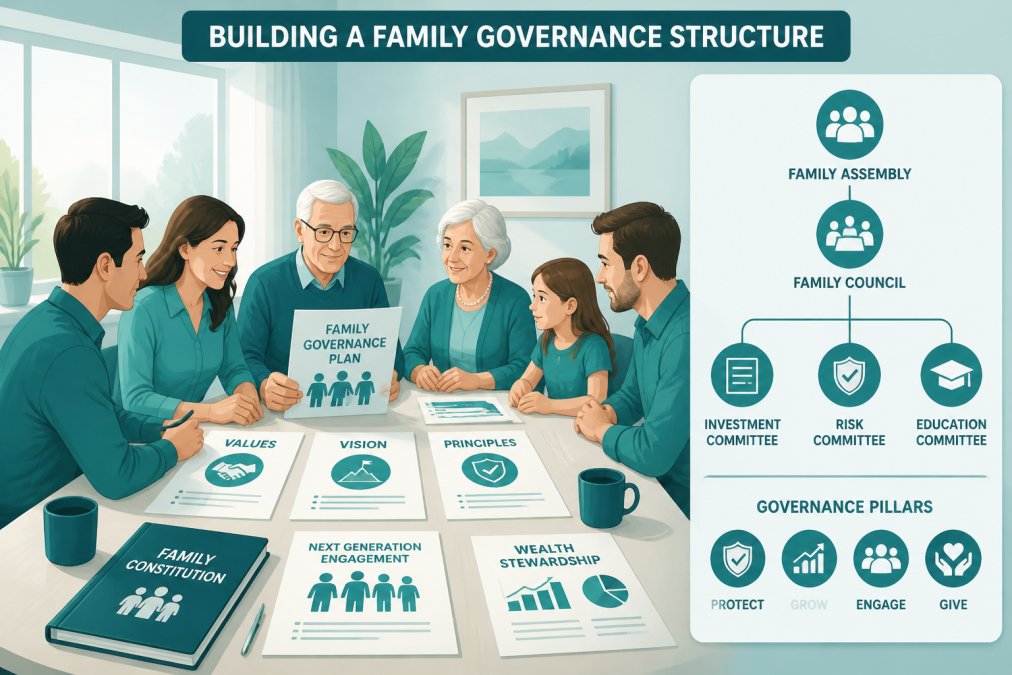
Family governance is the system by which your family makes financial decisions, communicates about money, and resolves disagreements. Without it, families often experience conflict when multiple heirs have different views about how assets should be managed or distributed.
A family governance structure typically includes a family mission statement that articulates shared values around money and wealth, regular family meetings where financial matters are discussed openly, clear roles and responsibilities, decision-making protocols for major financial choices, conflict resolution processes, and education programs to prepare younger family members for wealth management.
The process begins with honest conversations about your family's relationship with money. What values do you want to pass down? How do you want your wealth to be used, for education, starting businesses, charitable giving, security? What mistakes do you want to prevent? Many families find that documenting these conversations creates clarity that prevents misunderstandings later. A family mission statement might be as simple as: "Our family believes in financial responsibility, education, and giving back to our community. We want our children to understand the value of money and to use wealth as a tool for positive impact."
From that foundation, you establish governance structures appropriate to your family's size and complexity. A simple family might use annual meetings and straightforward decision-making. A larger family might benefit from a family council with defined roles, a family constitution that documents decision-making rules, or even a family office that professionally manages assets. The governance structure also addresses succession planning, who will manage assets when you're no longer able, and what training will that person need?
Families that invest in governance structures consistently report better outcomes: fewer disputes, more responsible use of assets, clearer communication, and stronger family relationships.
Creating Your Legacy Planning Checklist
A comprehensive legacy planning checklist ensures you've addressed all critical elements:
Documents and Legal Structure
- Current will or revocable living trust
- Beneficiary designations on all accounts (IRAs, 401(k)s, insurance policies, brokerage accounts)
- Healthcare power of attorney and living will
- Financial power of attorney
- Deed or title transfer documentation for real estate
- Beneficiary review for each account (outdated beneficiaries are a common mistake)
Asset Organization
- Complete inventory of all assets (bank accounts, investments, real estate, business interests, personal property)
- Location of all important documents (deeds, titles, account statements, insurance policies)
- Passwords and access information for digital accounts (stored securely)
- List of professional advisors (attorney, accountant, financial advisor)
Family Communication
- Family mission statement or values document
- Documented explanation of your wishes and reasoning
- Letter of intent describing how you want assets used
- Communication with heirs about your legacy plan
- Designation of who will manage assets and who will advise them
Tax and Asset Protection
- Review of estate tax implications
- Evaluation of trust structures for tax efficiency
- Life insurance assessment (amount and beneficiary alignment)
- Business succession plan (if you own a business)
- Creditor protection analysis
Ongoing Management
- Schedule for regular plan reviews (annually or when circumstances change)
- Process for updating documents as needed
- Plan for digital assets and online accounts
- Charitable giving strategy (if philanthropy is part of your legacy)
New Insight Financial's Generational Vault® provides secure online storage for these documents, making them accessible to your designated heirs and advisors while protecting them from loss or unauthorized access.
| Planning Component | Key Action | Timeline |
|---|---|---|
| Legal documents | Draft or update will, trusts, powers of attorney | Before retirement |
| Asset inventory | List all accounts, property, and valuables | Before retirement |
| Beneficiary review | Verify current beneficiaries on all accounts | Annually |
| Family communication | Discuss plans and values with heirs | Before retirement |
| Tax planning | Review strategies with CPA or advisor | Annually or when circumstances change |
| Document storage | Organize and secure all important papers | Before retirement |
Preparing Your Heirs and Communicating Your Values
One of the most overlooked aspects of legacy planning is preparing your heirs to handle wealth responsibly. Families that skip this step often experience poor outcomes, assets depleted within a generation, family conflict over money, or heirs unprepared for the responsibility of managing significant wealth.
Heir preparation begins with honest assessment of your children's financial literacy and maturity. Do they understand budgeting, investing, and long-term financial planning? Have they experienced managing significant sums of money?

Effective communication about your legacy plan should happen while you're alive and able to explain your thinking. This conversation typically includes your overall financial situation and asset value, your wishes for how assets should be used, the values that guided your financial decisions, your expectations for how heirs should manage inherited wealth, potential challenges they might face, and the role of professional advisors in managing complex assets. Many families find it helpful to involve a neutral third party, such as a financial advisor or attorney, in these conversations.
Beyond the initial conversation, ongoing education strengthens heirs' ability to manage wealth through regular family financial meetings, gradually increasing heirs' involvement in financial decisions before they inherit, providing access to financial education resources, allowing heirs to manage smaller amounts of money while you're available to coach them, and discussing real-world scenarios. The psychological impact of significant wealth transfer shouldn't be underestimated, heirs sometimes experience guilt, confusion about identity and purpose, or pressure to manage assets "perfectly." Acknowledging these emotional dimensions and providing support helps heirs adjust to their new circumstances.
A common concern is whether discussing inheritance will make children feel entitled or reduce their motivation to work. The evidence suggests the opposite: heirs who understand their family's values and have been involved in financial decision-making tend to be more financially responsible.
Tax Efficiency and Asset Protection Strategies
Tax efficiency in legacy planning means structuring your assets and transfers to minimize the amount lost to federal estate taxes, state taxes, and income taxes. Asset protection means arranging your holdings so they're shielded from creditors, lawsuits, and other claims. These strategies work together.
Common tax efficiency strategies include lifetime gifting (which allows you to transfer assets to heirs during your lifetime, reducing your taxable estate), irrevocable life insurance trusts (which remove life insurance proceeds from your taxable estate while providing liquidity), charitable remainder trusts (which allow you to make charitable gifts while receiving income during your lifetime), and spousal lifetime access trusts (which let married couples maximize their combined estate tax exemptions).
Asset protection strategies typically involve moving assets into structures that creditors cannot easily reach, including limited liability companies (LLCs) for real estate or business assets, qualified personal residence trusts that protect your home, and spendthrift trust provisions that prevent beneficiaries from creditors' claims.
The specific strategies that make sense depend on your state of residence, the nature of your assets, your family situation, and your goals. A strategy that works perfectly for one family might be inappropriate for another. Many families make the mistake of focusing only on tax reduction without considering the broader picture. The best approach balances multiple objectives: tax efficiency, asset protection, family harmony, and practical management.
Legacy planning for family assets requires attention to legal structures, but it succeeds or fails based on family communication and preparation. The families that achieve the best outcomes combine solid legal and tax planning with honest conversations about values, clear governance structures, and intentional preparation of heirs.
New Insight Financial specializes in helping families in the Winter Haven area and beyond build comprehensive legacy plans that address both the technical and human dimensions of wealth transfer. Our personalized approach considers your unique risk tolerance, family dynamics, and long-term goals. Through our Generational Vault® secure document storage and ongoing guidance, we help ensure your legacy plan remains organized, current, and aligned with your evolving circumstances. Get started today with a consultation to discuss how a comprehensive legacy plan can protect your family's future and reflect your values across generations.
Frequently Asked Questions
What is the difference between estate planning and legacy planning?
Estate planning focuses on the legal and financial mechanics of transferring assets after death, wills, trusts, probate avoidance, and tax minimization. Legacy planning goes deeper: it encompasses your values, family governance, heir preparation, and the long-term stewardship of your wealth. While estate planning answers 'how do I transfer my assets?', legacy planning asks 'what do I want my family to become?' and 'how do I ensure my values live on?' Both are essential, but legacy planning is the broader framework.
How do I start a family legacy plan for my assets?
Begin by documenting your financial picture: account consolidation, asset inventory, and beneficiary designations. Next, clarify your values and what you want to pass on beyond money. Meet with a financial advisor to assess tax implications and discuss trust structures. Then communicate your intentions to your family and establish a governance framework for decision-making. Finally, store all documents securely and update your plan every 3-5 years or after major life changes. A comprehensive legacy planning checklist ensures nothing is overlooked.
What role do legacy trusts play in protecting family assets?
Legacy trusts offer several protections: they avoid probate, maintain privacy, reduce estate taxes through strategic planning, and shield assets from creditors or legal claims. They also allow you to control how and when beneficiaries receive their inheritance, which is especially valuable if heirs lack financial experience. Living trusts take effect immediately, while testamentary trusts are created through your will. The right trust structure depends on your family situation, asset size, and long-term goals.
How do I communicate my legacy plan to my family without causing conflict?
Start early and be transparent. Hold a family meeting to explain your values, intentions, and the 'why' behind your decisions. Avoid surprises, which breed resentment. If your plan includes unequal distributions, explain your reasoning clearly. Consider involving a neutral third party, such as a financial advisor or family mediator, to facilitate the conversation. Provide each family member with a summary of their role and responsibilities. Document everything in writing and revisit the plan periodically to address concerns and adapt to changing circumstances.