 comparison
Is a Lifetime Income Annuity Worth It in 2026?
Table of Contents
- What Is a Lifetime Income Annuity?
- How Lifetime Annuities Work: Accumulation and Payout Phases
- Immediate vs. Deferred Annuities: Which Fits Your Timeline?
- The Real Cost: Understanding Annuity Surrender Charges and Fees
- Guaranteed Income vs. Market Risk: Weighing the Trade-offs
- Lifetime Annuities and Inflation: Protecting Your Purchasing Power
- Is a Lifetime Income Annuity Right for You? Decision Framework
- Frequently Asked Questions
Last Updated: August 16, 2026
What Is a Lifetime Income Annuity?
A lifetime income annuity is an insurance contract that converts a lump sum of money into a guaranteed stream of income payments for the rest of your life. You give the insurance company a large payment upfront, and in return, they commit to sending you regular checks for as long as you live, regardless of market conditions.
The core appeal is predictability. Unlike investment portfolios that fluctuate with market swings, a lifetime income annuity delivers the same payment amount every month. But "guaranteed" comes with trade-offs. Once you commit money to an annuity, you typically can't access the principal. If you die early, your heirs may receive nothing unless you've structured the annuity with a death benefit rider. The income stream doesn't automatically adjust for inflation, eroding purchasing power over time. And embedded fees can be substantial.
At New Insight Financial, we help clients evaluate whether converting a portion of their retirement savings into a guaranteed income stream makes sense for their specific situation. The question isn't whether lifetime income annuities are universally good or bad, it's whether they fit your particular mix of assets, income needs, and risk tolerance.
How Lifetime Annuities Work: Accumulation and Payout Phases
Most lifetime income annuities operate in two distinct phases: accumulation and payout.
The Accumulation Phase is the period between when you purchase the annuity and when it begins paying you. During this time, your money grows at a rate determined by the annuity contract. With a fixed annuity, the insurance company credits a guaranteed interest rate. With a variable annuity, your growth depends on the performance of investment sub-accounts you've selected, which means returns are not guaranteed.
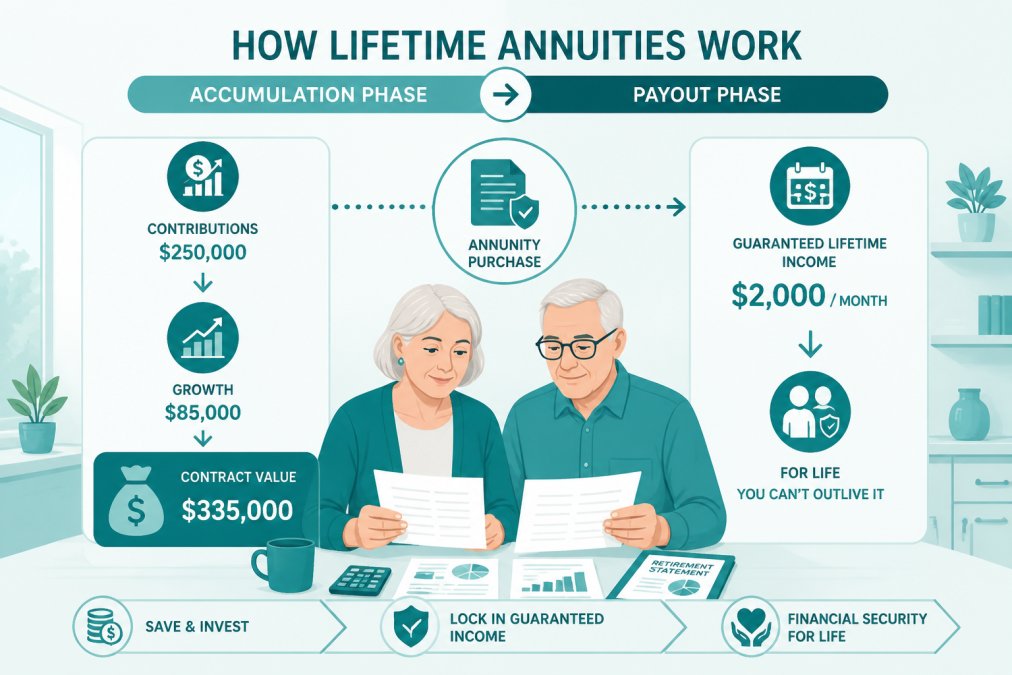
For deferred income annuities, the accumulation phase can last years or decades. You might purchase an annuity at age 55 and not receive a single payment until age 70 or 75. During those years, your money compounds, and when the payout phase begins, the insurance company calculates your monthly payment based on how much you've accumulated, your age, current interest rates, and your chosen payout option.
The Payout Phase is when the checks start arriving. Once annuitization occurs, the insurance company has locked in your payment amount. That number rarely changes unless you selected a cost-of-living adjustment rider, which increases payments annually by a fixed percentage.
The payout amount depends on several factors: how much you contributed, how long it accumulated, how old you are when payments begin, current interest rates, and which payout option you selected. Payments are typically higher if you choose a single-life option versus a joint-and-survivor option.
During the payout phase, each payment is partly a return of your principal and partly earnings. The insurance company calculates an "exclusion ratio" that determines how much of each payment is tax-free versus taxable. This can create meaningful tax efficiency compared to withdrawing from a regular investment account.
Immediate vs. Deferred Annuities: Which Fits Your Timeline?
An immediate annuity begins paying you within a year of purchase. You write a check to the insurance company, and within 12 months, monthly payments begin. This product is designed for people who are already retired or very close to it and need income now. The insurance company calculates your payment based on your age, the lump sum you've contributed, interest rates at that moment, and your payout option.
A deferred income annuity delays the start of payments. You might purchase one at age 55 with the intention of receiving income starting at age 70. During those 15 years, your contributions accumulate at a guaranteed rate. The advantage is that your money has longer to grow, resulting in higher monthly payments when the payout phase begins. The disadvantage is that you don't have access to those funds during the accumulation phase, and if you need the money before the payout date, you may face steep surrender charges.
Which one fits your timeline depends on your current age, when you plan to retire, and how much income you need right now versus later. The trade-off is flexibility versus growth. Immediate annuities sacrifice growth potential for immediate income. Deferred income annuities sacrifice liquidity during accumulation for higher payments later.
The Real Cost: Understanding Annuity Surrender Charges and Fees
Annuities carry multiple layers of costs that aren't always transparent.
Surrender charges are penalties you pay if you withdraw money from an annuity before a specified period ends. A typical surrender charge schedule might decline from 7% in year 1 to 0% after 7 to 10 years. If you withdraw $50,000 from an annuity with a 6% surrender charge, you pay $3,000 before touching the principal.
Beyond surrender charges, annuities have mortality and expense (M&E) fees, which are annual charges covering the insurance company's costs and profit. These typically range from 0.5% to 2% of your account balance annually. On a $500,000 annuity with a 1% M&E fee, you're paying $5,000 per year.
Variable annuities add investment management fees on top of M&E fees. If you choose sub-accounts with average expense ratios of 0.75%, and the annuity charges 1% in M&E fees, you're paying 1.75% annually. Over 20 years, that compounds significantly.
Some annuities also charge rider fees for optional features like inflation protection or guaranteed minimum income benefits. A cost-of-living adjustment rider might cost 0.25% to 0.5% annually.
Fixed annuities and immediate income annuities tend to be simpler and cheaper. Before you commit to any lifetime income annuity, ask for a full fee breakdown. Know your surrender charge schedule, your annual M&E fees, any rider costs, and what you're actually paying each year.
Guaranteed Income vs. Market Risk: Weighing the Trade-offs
The central tension with a lifetime income annuity is this: you're trading market upside for guaranteed income.
The case for guaranteed income is compelling if you're anxious about market volatility or running out of money. A guaranteed monthly check removes sequence-of-returns risk, the danger that a major market downturn early in retirement forces you to sell stocks at depressed prices. With a lifetime income annuity, you don't care if the stock market crashes. Your payment arrives regardless. This psychological benefit is real for many retirees.
The case against guaranteed income centers on opportunity cost. When you convert a lump sum into a fixed income stream, you're betting that the guaranteed rate of return is competitive with what you could earn elsewhere. If interest rates are low when you annuitize, your guaranteed payments might be modest. A diversified portfolio might deliver higher returns over the long term.
There's also the question of longevity. A lifetime income annuity pays off if you live a long time. If you die at 80, having converted $500,000 into income at age 65 might mean you received only a fraction of your principal back.
A balanced approach uses a lifetime income annuity to cover essential expenses and keeps the rest of your portfolio invested for growth and flexibility. This creates an income floor while preserving upside potential. New Insight Financial helps clients model this hybrid approach.
Lifetime Annuities and Inflation: Protecting Your Purchasing Power
A fixed monthly payment loses value every year due to inflation. If you receive $3,000 per month in 2026 and that payment never increases, in 2036 that same $3,000 will buy considerably less.
Some insurance companies offer cost-of-living adjustment (COLA) riders that automatically increase your payments by a fixed percentage each year, typically 2%, 3%, or 4%. This protects against inflation but comes at a cost. Your initial payment will be lower than it would be without the COLA rider.
Another approach is to use a deferred income annuity strategically. You might purchase one at age 55 to begin payments at age 75. By then, inflation will have eroded the value of your current savings, but your deferred annuity payment, calculated at age 75, can offset that loss.
If you choose a lifetime income annuity without inflation protection, you're accepting a gradual decline in purchasing power. This matters most if you live into your 80s or 90s. If you're concerned about inflation, factor in the cost of a COLA rider or plan to supplement your annuity income with other sources that do adjust for inflation, like Social Security.
Is a Lifetime Income Annuity Right for You? Decision Framework
Determining whether a lifetime income annuity makes sense requires honest answers to several questions.

Do you have a longevity concern? If you're worried about outliving your savings, a lifetime income annuity directly addresses that fear. If your family has a history of long lifespans or you're already in good health at 65, an annuity may provide genuine peace of mind. Conversely, if your health is poor, an annuity might not be the best use of capital.
How much guaranteed income do you actually need? Calculate your essential monthly expenses: housing, utilities, food, insurance, healthcare. If Social Security and any pensions cover those essentials, you might not need an annuity. If there's a gap, an annuity can fill it.
What's your risk tolerance? If market volatility genuinely distresses you, an annuity's certainty may be worth the trade-off. If you're comfortable with market fluctuations, keeping your money invested might serve you better.
Do you have other sources of guaranteed income? If you have a pension and Social Security, you already have guaranteed income. Adding an annuity may be redundant. If you have little guaranteed income, an annuity becomes more valuable.
How important is liquidity and flexibility? If you might need access to your money, an annuity's surrender charges and illiquidity are serious drawbacks. If your money is truly surplus, illiquidity matters less.
What are current interest rates? Annuity payouts are heavily influenced by prevailing interest rates. When rates are high, annuity payments are higher. When rates are low, payments are lower.
A practical framework: consider annuitizing 25% to 50% of your liquid assets if you want guaranteed income but also want to preserve flexibility and growth potential. This creates an income floor while keeping the majority of your portfolio invested. New Insight Financial works with clients to model different scenarios.
| Consideration | Favors Annuity | Favors Keeping Invested |
|---|---|---|
| Longevity history | Long family lifespans | Shorter lifespans |
| Risk tolerance | Low, anxiety-prone | High, comfortable with volatility |
| Guaranteed income needs | Large gap after SS/pension | Covered by existing sources |
| Liquidity needs | Minimal | High |
| Interest rate environment | High rates | Low rates |
A lifetime income annuity isn't a universal solution. It's a tool that works well for specific situations: retirees with significant longevity risk who need a guaranteed income floor and can tolerate illiquidity.
The decision ultimately depends on your specific circumstances, your age, health, income needs, risk tolerance, and how much of your portfolio you're willing to lock away. Working with a financial advisor who understands your complete situation is essential. At New Insight Financial, our approach is to help you stress-test different scenarios, understand the real costs and benefits of annuitization, and make a decision that aligns with your risk tolerance and retirement vision. We're committed to ensuring you have the information and guidance needed to make this significant financial decision with confidence.
Frequently Asked Questions
What are the main disadvantages of a lifetime income annuity?
The primary drawbacks include reduced liquidity (your money is locked into the contract), surrender charges if you need early access, and lost upside if markets perform exceptionally well. You also face longevity risk if you die early and have not selected a survivor benefit option, meaning your heirs may receive little or nothing. Inflation can erode purchasing power over decades unless you purchase a cost-of-living adjustment rider. Finally, annuity fees and commissions vary widely, and some products offer complex terms that can be difficult to understand.
How do immediate vs. deferred annuities differ in retirement planning?
An immediate annuity begins paying you within one year of purchase, making it ideal if you need income right away in early retirement. A deferred annuity delays payments for 2 to 40 years, allowing your contributions to grow during the accumulation phase before annuitization. Deferred annuities suit pre-retirees (ages 55-65) who want to lock in today's rates and build a guaranteed income floor for later. Immediate annuities work best for retirees who have already left the workforce and want to convert lump sums into predictable monthly checks immediately.
Does a lifetime annuity protect against inflation?
Standard lifetime annuities pay a fixed amount each month, so inflation erodes your purchasing power over time. However, many carriers offer optional cost-of-living adjustment riders that increase your payments by 1%, 2%, 3%, or 4% annually. These riders reduce your starting payment but help preserve buying power in retirement. Without this rider, a $3,000 monthly payment today may feel significantly smaller in 20 years due to inflation. It's critical to evaluate whether the rider cost is worth the inflation protection for your specific situation.
What happens to my money if I die early with a lifetime annuity?
With a basic single-life annuity, if you die before receiving all your contributions back, the remaining balance typically stays with the insurance company. This is a significant risk if longevity runs short in your family. However, you can select beneficiary protection options such as a period-certain rider (guarantees payments for 10, 15, or 20 years) or joint-and-survivor coverage (continues payments to your spouse). These riders reduce your monthly income but ensure your heirs receive a benefit if you pass away early. Always discuss beneficiary options with your advisor before purchasing.
Are lifetime annuities worth it in a high-interest rate environment?
Higher interest rates generally improve annuity payouts because insurance companies can invest your premium at better returns, passing some benefit to you through larger monthly payments. This makes annuities more attractive when rates are elevated. However, if rates are expected to rise further, locking in today's rates may not be optimal. Conversely, if rates are likely to fall, purchasing now locks in better income. The decision depends on your personal timeline, risk tolerance, and whether you need guaranteed income regardless of rate direction. Consulting with a financial advisor helps you time the purchase to your retirement goals.