 how-to
How to Organize Retirement Financial Documents: A Step-by-Step Guide
Table of Contents
- Why Organizing Your Retirement Financial Documents Matters
- Step 1: Gather All Your Financial Records
- Step 2: Create a Financial Document Retention Schedule
- Step 3: Build Your Checklist for Retirement Planning Documents
- Step 4: Choose the Best Digital Filing System for Personal Finance
- Step 5: How to Organize Estate Planning Documents for Your Heirs
- Step 6: Implement Security and Access Controls
- Step 7: Audit and Maintain Your System Annually
- Frequently Asked Questions
Last Updated: August 7, 2026
Why Organizing Your Retirement Financial Documents Matters
Retirement brings freedom from the daily grind, but it also brings complexity. Your financial life doesn't simplify when you stop working, it shifts. Suddenly, you're managing distributions instead of contributions, tracking multiple income streams, coordinating with heirs, and protecting assets you've spent decades building. At the center of all this sits one unglamorous but critical task: organizing your retirement financial documents.
Most people don't think about this until crisis forces their hand. A spouse passes away. A medical emergency requires immediate access to insurance details. An audit lands on your doorstep. That's when scattered documents become a nightmare, and when you wish you'd spent a weekend organizing them years earlier.
The real cost of disorganization isn't just stress. It's money. Missing statements lead to missed tax deductions. Unclear beneficiary designations mean probate delays and family conflict. Lost insurance policies mean lost coverage. Duplicate accounts across institutions mean paying fees you shouldn't be paying. When you learn how to organize retirement financial documents properly, you reclaim control over your financial life and protect your family's future.
This guide walks you through a practical system for organizing retirement financial documents that works whether you're still working toward retirement or already in it. We'll cover everything from gathering scattered records to securing them digitally to ensuring your heirs can actually find what they need when the time comes.
Step 1: Gather All Your Financial Records
The first step sounds simple but requires real work: find everything. Most people have financial records scattered across multiple locations, some in filing cabinets, some in drawers, some in email attachments, some in accounts they haven't thought about in years.
Start with a physical search. Check every drawer, filing cabinet, and storage box in your home. Look for bank statements, investment account statements, insurance policies, mortgage documents, retirement account statements, and tax returns. Pull out the last three years of statements from each account. Don't worry about organizing yet, just create a pile of everything financial.
Next, do a digital search. Check your email for statements, confirmations, and account notifications. Log into your bank and brokerage accounts to verify you have access and to see what accounts exist. Many people discover forgotten 401(k)s from old employers or investment accounts they'd completely forgotten about during this step.
Create a master list of every financial account you own. Include the institution name, account type, account number, and login information (store this securely, not in the list itself). This becomes your reference document for the next steps.
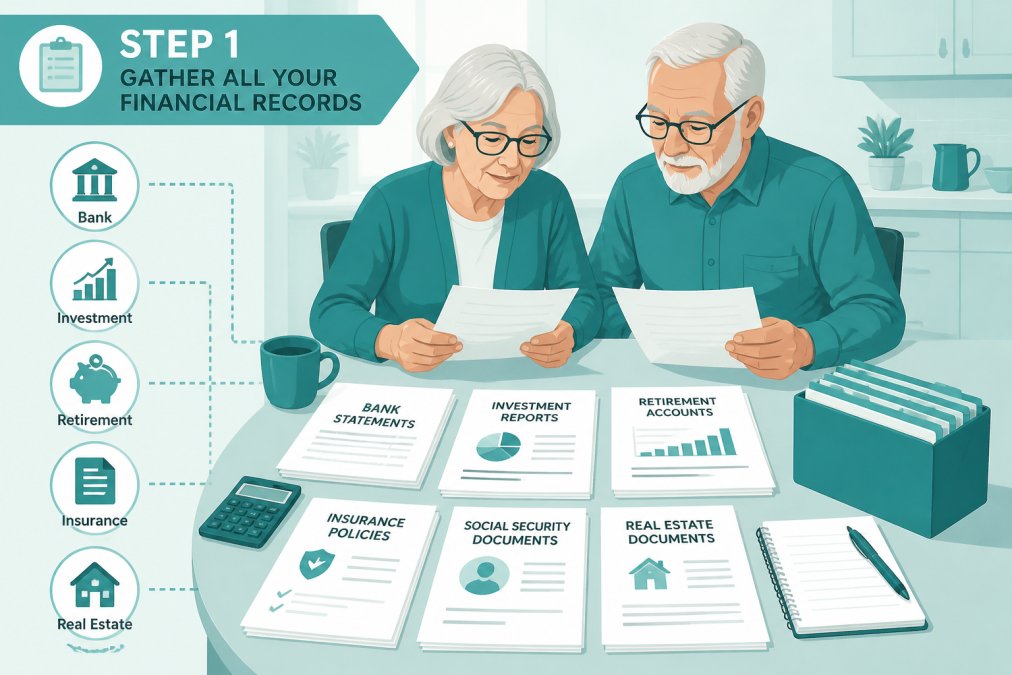
Don't skip accounts you think are inactive. Forgotten 401(k)s from previous employers, old savings accounts, or investment accounts from years ago all need to be accounted for. A common mistake is assuming you've found everything when you've only found what you use regularly. The accounts you forget about are often the ones that cause problems later.
Step 2: Create a Financial Document Retention Schedule
Not every document needs to be kept forever. Creating a financial document retention schedule tells you what to keep, for how long, and when you can safely discard it. This prevents your system from becoming a warehouse of useless paper while ensuring you keep what actually matters.
Start with the critical documents that need permanent retention. These include original birth certificates, marriage licenses, divorce decrees, wills, powers of attorney, and deeds to real property. Store these permanently in a secure location, either a safe deposit box or a digital vault designed for essential documents.
For tax-related documents, the IRS generally allows you to discard federal tax returns and supporting documents seven years after filing. State returns may require longer retention. Keep all tax returns themselves permanently, but supporting documents like receipts and invoices can follow the seven-year rule.
Bank and investment statements can typically be discarded after seven years, unless they document a major transaction like a home purchase or significant investment. Utility bills and routine statements can be discarded after one year. Insurance policies should be kept for the duration of coverage, plus three years after the policy ends.
Create a simple chart showing document type, retention period, and disposal date. Update it annually. This prevents you from keeping unnecessary paper while ensuring you never accidentally discard something you need.
Step 3: Build Your Checklist for Retirement Planning Documents
A comprehensive checklist for retirement planning documents ensures you don't miss critical items. This checklist becomes your inventory, the master list of everything that should be in your system.
Essential retirement planning documents include:
- Social Security statements and benefit estimates
- Medicare enrollment confirmation and coverage details
- Pension statements and distribution election forms
- 401(k) and IRA account statements and beneficiary designations
- Brokerage and investment account statements
- Insurance policies (life, health, long-term care, homeowners, auto)
- Property deeds and mortgage documents
- Will and testament
- Power of attorney documents (financial and healthcare)
- Living will and advance healthcare directives
- Trust documents if applicable
- Beneficiary designation forms from all retirement accounts
- Bank account statements and routing information
- Credit card account information
- Loan documents and payment schedules
- Investment prospectuses and fund information
- Annuity contracts and illustrations
- Long-term care insurance policies and benefit details
- Veteran benefits documentation if applicable
- Divorce decrees with financial implications
- Prenuptial or postnuptial agreements
Print this checklist and physically check off each item as you locate it. This forces you to confront gaps in your documentation. If you can't find your original will, you need to address that now, not when probate is imminent. If you're missing beneficiary designation forms, you need to contact your financial institutions immediately.
Step 4: Choose the Best Digital Filing System for Personal Finance
Digital storage has become essential for modern document organization. A best digital filing system for personal finance balances security, accessibility, and ease of use. The right system lets you access critical documents from anywhere while protecting sensitive information from unauthorized access.
Your digital filing system should include three components: a secure cloud storage solution, a password manager, and a document locator. The cloud storage holds scanned documents and digital records. The password manager stores login credentials for financial accounts. The document locator is a simple spreadsheet or document that lists where everything is stored.
Many financial institutions now provide secure document storage through their platforms, but these are fragmented, your bank's system doesn't talk to your brokerage's system. A unified solution works better. Some people use encrypted cloud services like Proton Drive or Tresorit. Others use dedicated financial document platforms. The critical features are encryption, backup redundancy, and the ability to share access with designated heirs or advisors if needed.

When choosing your system, prioritize security over convenience. Two-factor authentication should be non-negotiable. Your system should encrypt documents both in transit and at rest. It should offer version history so you can recover previous versions of documents. It should allow you to designate emergency contacts who can access documents if you become incapacitated.
New Insight Financial recommends a tiered approach: use your financial institutions' native document storage for routine statements, supplement with a dedicated secure vault for sensitive documents, and maintain a master index that tells you where everything is.
Step 5: How to Organize Estate Planning Documents for Your Heirs
Estate planning documents require special attention because they directly affect what happens to your assets after you die. How to organize estate planning documents for your heirs means making sure they can actually find and understand what you've left them, and can execute your wishes without chaos.
Start by consolidating all estate planning documents in one secure location. This includes your will, any trusts, beneficiary designations, power of attorney documents, and healthcare directives. Print originals and store them in a safe deposit box or home safe. Store digital copies in your secure digital vault.
Create a personal document locator, a detailed guide that tells your heirs exactly where everything is and how to access it. Include the location of your safe deposit box and the key, the login credentials for your digital vault, the names and contact information for your executor and any trustees, and instructions for what to do first when you die.
Many people keep this information only in their head, which creates a nightmare for heirs. Your spouse might not know which account holds your life insurance. Your children might not know about a safety deposit box. Your executor might not know how to access your digital files. A written personal document locator solves this problem.
Consider naming a successor executor or trustee, someone who understands your wishes and can step in if your primary choice becomes unable or unwilling. Brief this person on your overall financial situation and where documents are stored. They don't need to know every detail, but they need to know where to find it.
Update beneficiary designations on all retirement accounts and insurance policies. These override your will, so outdated designations can derail your estate plan. Review them every three to five years or whenever your family situation changes.
Step 6: Implement Security and Access Controls
Organizing documents is only half the battle. The other half is protecting them from identity theft, unauthorized access, and loss. Security and access controls ensure that sensitive information stays private while remaining accessible when you need it.
Start with physical security. Documents containing Social Security numbers, account numbers, and personal information should be stored in a locked safe or safe deposit box, not in an unlocked filing cabinet. Shred documents you no longer need, don't just throw them away. A shredder that cuts into small pieces is better than one that strips paper into long ribbons.
For digital documents, encryption is non-negotiable. Use a password manager to store login credentials, never write them down on sticky notes. Use strong, unique passwords for each account, at least 16 characters with a mix of uppercase, lowercase, numbers, and symbols. Enable two-factor authentication on every account that offers it.
Consider the access question carefully. Who should be able to access your documents if you become incapacitated? Your spouse? Your adult children? Your executor? Your financial advisor? You can grant different people access to different documents. Your financial advisor might need access to account statements but not your healthcare directives. Your executor needs access to everything but only after you die.
Some people give a trusted family member a copy of their password manager master password, stored in a sealed envelope with instructions to open only in case of incapacity. Others use designated emergency contacts built into their digital vault. Whatever approach you choose, test it. Ask your designated person to actually log in and verify they can access what they need.
Step 7: Audit and Maintain Your System Annually
Creating an organized system is the hard work. Maintaining it is the ongoing discipline. An annual audit ensures your system stays current and catches problems before they become crises.
Schedule an annual review, perhaps on your birthday or New Year's Day. Pull up your master list of accounts and verify each one still exists and is still active. Log into each account to confirm you still have access. Check that beneficiary designations are still correct. Review your document retention schedule and discard anything that's past its retention date.
Update your personal document locator with any changes. If you've opened new accounts, closed old ones, changed passwords, or updated beneficiaries, your locator needs to reflect that. If you've moved important documents, update where they're stored.
Look for duplicate accounts. Many people end up with multiple IRAs or brokerage accounts from different employers or life stages. Consolidating accounts simplifies your life and reduces fees. This is also a good time to review whether your investment allocations still match your risk tolerance and retirement timeline.
Check your digital vault's backup status. Confirm that your documents are being backed up regularly and that you can restore them if needed. Test your disaster recovery process, actually download a backup and verify it works.
A common mistake is treating document organization as a one-time project. It's not. Your financial life changes every year. New accounts open, old ones close, beneficiaries change, and regulations shift. The system you build today needs maintenance to stay effective.
Organizing your retirement financial documents isn't glamorous, but it's one of the most important things you can do for your family's financial security. When you have a clear system in place, you know exactly where everything is. Your heirs know where to find what they need. Your executor can settle your estate without chaos. You can sleep better knowing your affairs are in order.
New Insight Financial helps you organize more than just documents, we help you organize your entire retirement strategy. With access to our Generational Vault® for secure document storage and our personalized retirement planning guidance, you can consolidate scattered accounts, clarify your income sources, and create a comprehensive plan that protects your family's future. Start today by scheduling a consultation to discuss your specific situation and how we can help you prepare for a more secure retirement.
Frequently Asked Questions
What financial documents should I keep permanently?
Keep permanent records of birth certificates, Social Security cards, marriage certificates, divorce decrees, wills, powers of attorney, property deeds, and investment account statements showing cost basis. Retirement account beneficiary designations and life insurance policies should also be retained indefinitely. These vital records form the foundation of your estate planning and prove ownership of assets.
How long should I keep tax returns and supporting documents?
The IRS recommends keeping tax returns and supporting documents for at least three years, though seven years is safer in case of an audit. Keep records longer if you claim business losses or don't report income. For retirement planning, maintain tax returns indefinitely to track income patterns and validate Social Security earnings records, which affects your benefit calculations.
How do I organize financial documents for my heirs?
Create a personal document locator that lists all accounts, locations, and access information. Include beneficiary designations, account numbers, and contact details for financial institutions. Store this alongside your will and power of attorney documents in a secure, accessible location. Your heirs need to know where to find everything quickly, consider using a digital vault or shared secure storage system that your executor can access when needed.
What's the best way to store sensitive retirement documents?
Use encrypted cloud storage or a secure digital vault for easy access and backup protection. Keep original vital records in a safe deposit box or home safe. Avoid storing sensitive documents on regular cloud services like Google Drive. A dedicated platform designed for estate planning provides security, organization, and the ability to grant access to heirs or executors when the time comes.