 comparison
Best Retirement Income Planning Tools: 2026 Comparison
Table of Contents
- Best Retirement Income Planning Tools: Quick Comparison
- What Makes a Strong Retirement Income Planning Tool
- Top Retirement Income Planning Tools Reviewed
- 1. New Insight Financial: Personalized Retirement Planning with Risk Mitigation
- 2. help Personal Dashboard: Free Investment Tracking Meets Retirement Projections
- 3. Boldin (formerly NewRetirement): Advanced Tax Planning and Scenario Modeling
- 4. MaxiFi Planner: Economics-Based Lifetime Spending Optimization
- 5. Fidelity Retirement Planner: Free, Integrated Planning for Fidelity Customers
- Free Retirement Planning Tools vs. Paid Options
- Retirement Income Strategies and Withdrawal Planning
- Tax-Efficient Retirement Planning Software Reviews
- How to Choose the Right Retirement Income Planning Tool for Your Needs
- Integration with Financial Advisors and Long-Term Plan Maintenance
- Frequently Asked Questions
Last Updated: July 17, 2026
Best Retirement Income Planning Tools: Quick Comparison
Finding the right retirement income planning tools can mean the difference between a comfortable retirement and financial stress. Individuals using comprehensive planning tools are significantly more likely to feel confident about their retirement readiness.

This guide covers the top retirement income planning tools available in 2026, comparing their features, pricing, and best use cases.
| Tool | Best For | Free Tier | Key Feature |
|---|---|---|---|
| New Insight Financial | Personalized risk mitigation | No | Customized strategies + Generational Vault® |
| help Personal Dashboard | Free investment tracking | Yes | Real-time Monte Carlo simulations |
| Boldin | Advanced tax planning | Yes (basic) | Roth conversion optimization |
| MaxiFi Planner | Lifetime spending optimization | No | Economics-based consumption smoothing |
| Fidelity Retirement Planner | Existing Fidelity customers | Yes | Integrated account tracking |
What Makes a Strong Retirement Income Planning Tool
Monte Carlo simulations represent the gold standard for retirement projections. Rather than assuming fixed returns, these tools run thousands of scenarios with varying market conditions to show the probability your plan succeeds. A plan that works 95% of the time differs fundamentally from one that works 70% of the time.
Tax planning integration separates adequate tools from excellent ones. A retirement income planning tool ignoring taxes misses one of the largest retirement expenses. The best tools model federal and state taxes, identify Roth conversion opportunities, and show how Social Security claiming age affects lifetime tax burden.
Scenario modeling and what-if analysis let you stress-test your plan against early retirement, lower returns, or healthcare cost spikes. Real-time account linking distinguishes tools working with your actual situation from those using assumptions.
A strong retirement income planning tool must address the four major retirement financial risks: longevity risk, market risk, inflation risk, and healthcare risk.
Top Retirement Income Planning Tools Reviewed
1. New Insight Financial: Personalized Retirement Planning with Risk Mitigation
New Insight Financial combines comprehensive retirement income planning with risk mitigation strategies tailored to your specific situation. Rather than pushing one-size-fits-all products, they customize financial strategies based on individual risk tolerance and timing preferences.
The core offering includes personalized retirement income planning, life insurance optimization, and Medicare navigation. The Generational Vault® provides secure online storage for essential financial and legal documents, ensuring your family can access critical information when needed.
Pros:
- Customized strategies considering individual risk tolerance
- Complimentary Generational Vault® for secure document storage
- Expertise in mitigating four major retirement financial risks
Cons:
- Requires direct engagement with advisors (not self-service)
- More comprehensive than needed for simple situations
Best For: Individuals and couples seeking personalized guidance with complex situations involving pensions, multiple income sources, or significant assets.
2. help Personal Dashboard: Free Investment Tracking Meets Retirement Projections
help Personal Dashboard represents the most accessible entry point for comprehensive retirement planning. The free tier provides investment tracking, net worth aggregation, and retirement projections without requiring credit card or advisory commitment.
The retirement planner uses real-time linked account data and Monte Carlo simulations to project retirement readiness. The investment checkup feature analyzes your portfolio for proper asset allocation and identifies hidden fees. Many investors discover they're paying 1-2% annually in fees they never knew existed.
Pros:
- Strong free tools for investment analysis and retirement projections
- Real-time linked account data for accurate modeling
- Fee analyzer reveals hidden costs
Cons:
- Business model incentivizes moving to paid advisory services
- Free tier lacks advanced tax optimization features
Best For: Individuals seeking comprehensive free retirement planning tools, especially those with significant investable assets.

3. Boldin (formerly NewRetirement): Advanced Tax Planning and Scenario Modeling
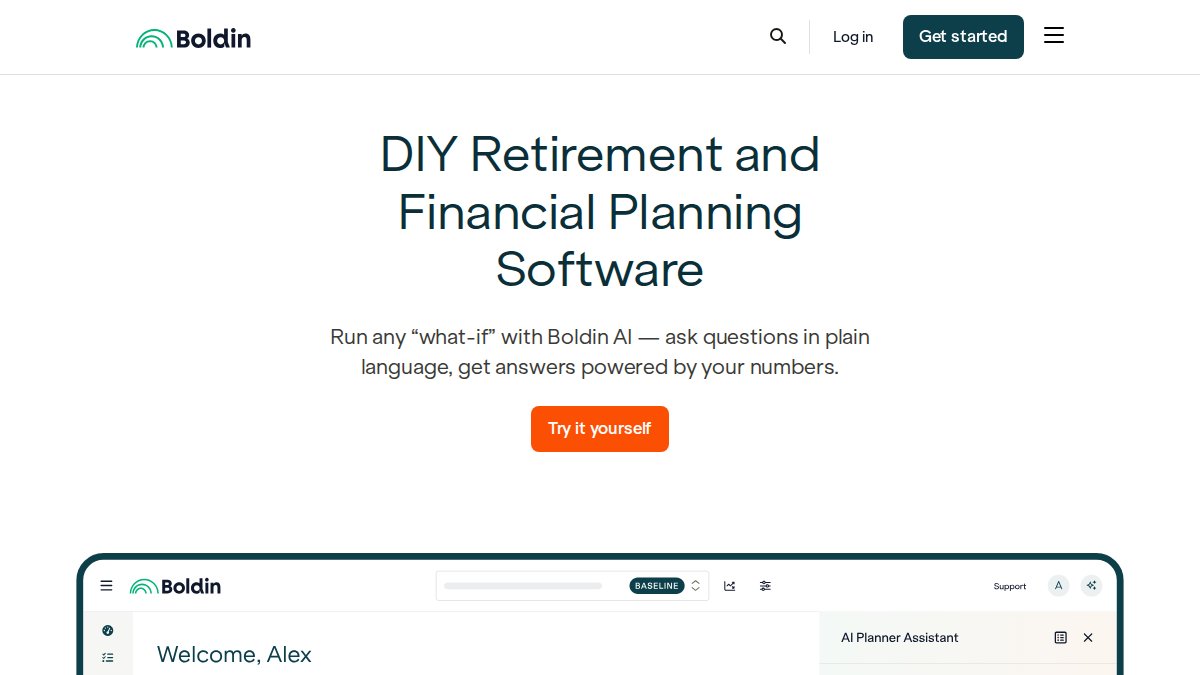
Boldin excels at detailed retirement planning with advanced tax optimization and scenario modeling. The platform creates personalized lifetime financial plans forecasting income, expenses, and net worth across your entire retirement.
The scenario modeling lets you test hundreds of variations: different retirement ages, savings rates, Social Security claiming strategies, and spending patterns. The Roth conversion explorer stands out as a specialized feature most tools ignore, analyzing whether conversions make sense for your situation and showing whether paying taxes today saves more in taxes later.
Tax projections include state and federal calculations. The basic free tier provides lifetime planning and scenario modeling. PlannerPlus subscription ($144 annually) unlocks the Roth conversion optimizer and advanced tax analysis.
Pros:
- Highly detailed and customizable retirement planning
- Advanced what-if scenario modeling with Monte Carlo analysis
- Roth conversion optimizer saves significant taxes
- Free basic tier provides genuine value
Cons:
- Most useful features require paid subscription
- Complexity can overwhelm new users
Best For: Analytically-minded individuals seeking in-depth tax optimization and scenario testing.
4. MaxiFi Planner: Economics-Based Lifetime Spending Optimization
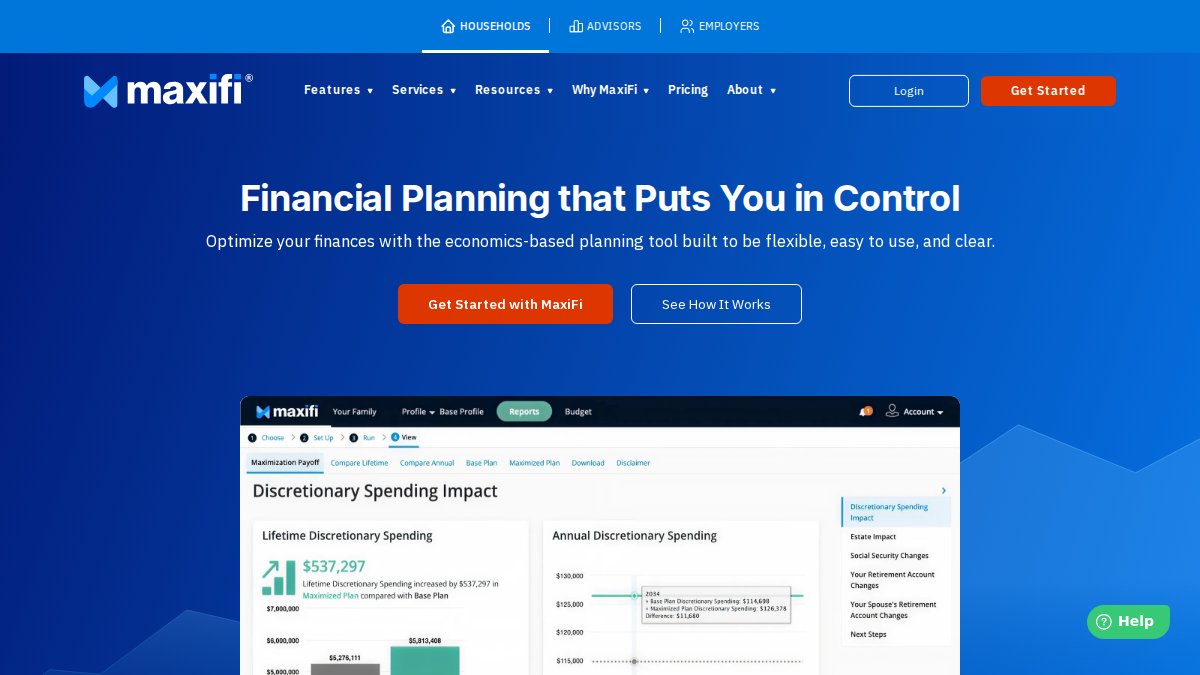
MaxiFi Planner focuses on maximizing lifetime discretionary spending rather than just accumulating assets. The economics-based methodology calculates the highest sustainable spending level you can maintain throughout your life, adjusting for taxes, inflation, and market returns.
The Roth conversion optimizer identifies conversions increasing lifetime spending capacity. By paying taxes on conversions early, you reduce future required minimum distributions and Social Security taxation, ultimately allowing higher sustainable spending.
MaxiFi's premium plans include Living Standard Monte Carlo simulations showing how investment volatility affects sustainable spending. The Standard plan costs $109 first year ($89 renewal). Premium is $149 first year ($109 renewal), and Premium Plus is $359 annually.
Pros:
- Academically rigorous approach to lifetime financial planning
- Focuses on maximizing sustainable spending
- Advanced Roth conversion and tax optimization tools
Cons:
- Can be complex with steeper learning curve
- No free tier available
Best For: Individuals focused on optimizing lifetime discretionary spending and tax efficiency.
5. Fidelity Retirement Planner: Free, Integrated Planning for Fidelity Customers
Fidelity Retirement Planner provides straightforward, free retirement planning for existing Fidelity account holders. The retirement readiness assessment shows your savings progress relative to retirement age and spending goals. The healthcare cost estimator addresses one of retirement's largest unknowns. Asset allocation guidance considers your risk tolerance and time horizon.
The main limitation is depth. Fidelity Retirement Planner handles basic planning well but lacks advanced features like Roth conversion optimization, detailed tax modeling, or Monte Carlo simulations.
Pros:
- Completely free for Fidelity account holders
- Simple, intuitive interface
- Integrates directly with existing Fidelity accounts
Cons:
- Limited depth compared to dedicated planning software
- No advanced optimization features
Best For: Existing Fidelity customers seeking basic retirement readiness assessment.
Free Retirement Planning Tools vs. Paid Options
Free tools like help Personal Dashboard and Boldin's basic tier work well for investors with straightforward situations: stable income, moderate assets, and standard retirement goals. They excel at baseline planning and understanding whether you're on track.
The limitation is feature depth. Advanced tax optimization, Roth conversion analysis, and detailed Monte Carlo modeling typically require paid subscriptions. For investors with significant assets or complex income sources, paid tool costs often pay for themselves through tax savings alone.
Paid retirement income planning tools ($100-$400 annually) justify their cost through specialized features. MaxiFi Planner's consumption smoothing, Boldin's Roth conversion optimizer, and similar advanced features address specific optimization opportunities generic tools miss. A single well-executed Roth conversion might save $5,000+ in lifetime taxes.
Professional advisory services (0.5-1.5% of assets annually) provide personalized guidance, ongoing plan reviews, and behavioral coaching. They're appropriate for investors with substantial assets ($500K+) or complex situations.
Retirement Income Strategies and Withdrawal Planning
Retirement income planning tools are only valuable if they help you implement sound withdrawal strategies.
The 4% rule provides a simple framework: withdraw 4% of your portfolio in year one, then adjust for inflation annually. This approach historically provided 95% success rates across historical market conditions.
Dynamic withdrawal strategies adjust spending based on market performance. When markets perform well, you increase spending. When markets struggle, you reduce spending slightly, maintaining portfolio longevity better than fixed withdrawals.
Bucketing strategies divide your portfolio into time-based buckets: immediate spending (1-2 years), medium-term (3-10 years), and long-term growth. You spend from the immediate bucket while letting long-term buckets grow, reducing sequence-of-returns risk.
Tax-efficient withdrawal sequencing determines which accounts you draw from first. Generally, you withdraw from taxable accounts before tax-advantaged accounts, preserving growth in tax-deferred accounts.
Social Security optimization represents a critical income strategy many retirees get wrong. Claiming age affects lifetime benefits significantly. Tools modeling claiming at 62, 67, and 70 show break-even ages and help you decide based on life expectancy and other income sources.
Tax-Efficient Retirement Planning Software Reviews
Tax efficiency often determines whether you run out of money in retirement or leave a legacy. The difference between tax-efficient and tax-naive plans can exceed $100,000 over 30 years.
Tax projection capabilities should show federal and state taxes under different scenarios. Tools ignoring state income tax miss significant optimization opportunities. Some states have no income tax on retirement income, making relocation a viable tax strategy.
Roth conversion modeling identifies conversions reducing lifetime taxes. The tool should show how conversions affect current taxes, future required minimum distributions, and Social Security taxation.
Medicare premium impact analysis matters because higher income triggers higher Medicare Part B and D premiums. Few tools model Medicare premiums, making those that do particularly valuable.
Required Minimum Distribution (RMD) planning becomes critical at age 73. Strategic Roth conversions before RMDs begin can significantly reduce lifetime taxes.
Boldin's tax modeling stands out for depth. MaxiFi Planner's Roth conversion optimizer identifies specific conversion opportunities. New Insight Financial's personalized approach ensures tax planning considers your specific situation, including income sources, state residency, and family circumstances.
How to Choose the Right Retirement Income Planning Tool for Your Needs
Selecting the right tool requires matching your situation's complexity to the tool's capabilities.
For simple situations (straightforward income, moderate assets, standard retirement goals), a free tool like Fidelity Retirement Planner or help Personal Dashboard provides sufficient depth.
For moderately complex situations (multiple income sources, significant assets, some tax considerations), a paid tool like Boldin or MaxiFi Planner justifies its cost through advanced features. The ability to model Roth conversions and optimize Social Security often identifies thousands in annual savings.
For complex situations (significant assets, multiple properties, business interests, complex family circumstances), professional guidance through New Insight Financial ensures your plan accounts for nuances generic tools might miss.
Consider these factors: situation complexity, your comfort with technology, integration needs, ongoing support preferences, and whether you want professional guidance.
Start with a free tool to establish baseline plans. If you identify optimization opportunities, upgrade to paid software or seek professional guidance.
Integration with Financial Advisors and Long-Term Plan Maintenance
A retirement plan requires ongoing adjustment as markets change, tax laws change, and your circumstances change.
Annual plan reviews should incorporate new market data, updated life expectancy assumptions, and changed circumstances. Tools facilitating annual reviews help you stay on track rather than discovering problems years later.
Integration with professional advisors works best when your tool and advisor align on methodology. New Insight Financial ensures alignment by providing both planning tools and personalized guidance based on your specific situation.
Behavioral coaching prevents common retirement mistakes. Market downturns trigger panic selling. Unexpectedly high healthcare costs trigger spending cuts. Tools modeling scenarios and advisors explaining them help you maintain discipline during stressful periods.
Plan adaptability matters as your life changes. Retirement at 62 instead of 67 requires plan adjustment. The best tools accommodate these changes without requiring complete plan restart.
The most successful retirees combine retirement income planning tools with periodic professional review. Tools provide analysis. Advisors provide context and behavioral coaching. Together, they create plans that adapt as circumstances change and maintain discipline during market volatility.
Choosing the right retirement income planning tool is a critical first step toward a secure retirement. Whether you need personalized guidance, advanced tax optimization, or simple baseline planning, tools exist to match your needs and budget. New Insight Financial combines comprehensive planning with risk mitigation strategies tailored to your individual circumstances, helping you prepare for a more secure and enjoyable retirement. Get started today and take control of your retirement income strategy.
Frequently Asked Questions
What is the best free retirement planning tool?
Empower Personal Dashboard and Fidelity Retirement Planner both offer strong free options. Empower provides comprehensive investment tracking with Monte Carlo simulations, ideal if you have multiple accounts. Fidelity's tool is best if you're already a Fidelity customer and want seamless integration. Boldin's free basic tier works well for simple retirement income planning, though paid features unlock advanced tax and scenario modeling.
What features should I look for in retirement income planning software?
Essential features include Monte Carlo simulations for probability-based projections, Social Security optimization, tax planning capabilities, and scenario modeling ('what-if' analysis). Look for tools that handle withdrawal strategies, account type optimization (401k, IRA, taxable accounts), and inflation adjustments. Advanced features like Roth conversion analysis and Required Minimum Distributions (RMD) planning are valuable for tax-efficient retirement planning.
How do retirement income calculators work?
Retirement income planning tools aggregate your financial data, income sources, savings, expenses, and assets, to project whether your money will last through retirement. Most use Monte Carlo simulations, running thousands of scenarios with different market returns to calculate success probability. They factor in inflation, life expectancy, tax implications, and Social Security benefits to estimate sustainable withdrawal rates and identify income gaps early.
What are the main differences between retirement income strategies?
Common retirement income strategies include the 4% rule (withdrawing 4% annually), dynamic withdrawal strategies (adjusting based on market performance), and income annuitization (converting savings into guaranteed income). Some focus on tax-efficient sequencing across account types, while others prioritize Social Security timing optimization or Roth conversions. The best strategy depends on your pensions, healthcare costs, life expectancy, and risk tolerance.
Can I use retirement planning tools if I work with a financial advisor?
Yes, many professionals use these tools alongside advisor guidance. New Insight Financial provides personalized strategies that complement software tools, offering expertise in mitigating major retirement risks and customizing plans to your specific situation. Some platforms like Boldin offer CFP consultation services, and Empower integrates advisory services. Tools help advisors model scenarios faster and give you visibility into your retirement income projections between meetings.